
CAS Verdict Explained: How Senegal regained the 2025 AFCON Title from Morocco
A 14-minute walk-off, a disputed penalty and a controversial decision by African football’s governing body turned a night of celebration in Rabat into a 10-month legal battle. In Lausanne, the Court of Arbitration for Sport has restored Senegal’s victory, delivering a ruling with implications beyond the destination of the trophy.
For Senegal, the Africa Cup of Nations final in Rabat was supposed to be remembered for Pape Gueye’s extra-time winner, Edouard Mendy’s penalty save and a team that had overcome the pressure of playing against the tournament hosts to become champions of Africa.
Instead, January 18, 2026, became the beginning of one of the most extraordinary disputes in the history of African football.
The final had been played. The winning goal had been scored. The referee had blown his whistle. Senegal had celebrated their 1-0 victory over Morocco.
Then, two months later, the Confederation of African Football (CAF) overturned the result, declared Senegal to have forfeited the match and awarded Morocco a 3-0 victory.
For nearly eight months, the official ownership of the continental title became a matter of legal interpretation rather than what had happened during the 120 minutes of football in Rabat.
On Tuesday, November 24, the Court of Arbitration for Sport (CAS) delivered its verdict.
In a unanimous decision, the Lausanne-based tribunal upheld Senegal’s appeal, overturned the CAF Appeal Board’s ruling and restored the original result. Senegal were reinstated as the 2025 Africa Cup of Nations champions.
The decision ended the immediate dispute over the title, but its significance reaches further into the relationship between football’s laws, tournament regulations and the authority of match officials.
At the centre of it all was a deceptively simple question: once a referee has allowed a match to resume and subsequently completed it, can a governing body later declare that the team that walked off the pitch had forfeited the contest?
CAS’s answer has now returned the trophy to Senegal.
A night in Rabat that refused to end
The controversy began in the closing moments of regulation time at the Prince Moulay Abdellah Stadium.
Senegal and Morocco were locked in a tense final when referee Jean-Jacques Ndala awarded the hosts a penalty following a VAR review.
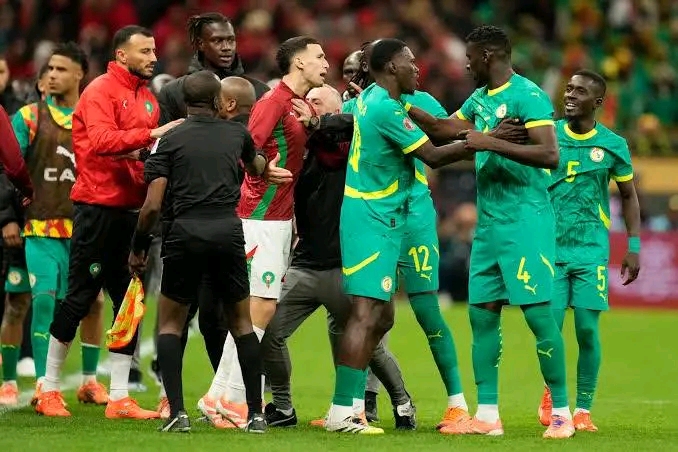
The decision provoked an angry reaction from the Senegalese players. In protest, members of the team left the field, and the match was interrupted for approximately 14 minutes.
The situation threatened to overshadow the final itself. Senegal’s players eventually returned, the match resumed and Morocco were given the opportunity to take the penalty.
Brahim Diaz failed to convert from the spot, with Mendy saving his effort.
The contest proceeded into extra time, where Gueye scored the goal that gave Senegal a 1-0 victory.
The final whistle appeared to settle the matter. Senegal were champions, Morocco were runners-up and the tournament had its winner.
But the walk-off had created a separate disciplinary question that would eventually take the result beyond the jurisdiction of the match officials and into CAF’s legal structures.
When the result changed in the boardroom
Morocco challenged the circumstances surrounding Senegal’s temporary departure from the pitch, arguing that the action violated the competition regulations.
CAF’s Disciplinary Board initially dealt with the matter, but the Moroccan Football Federation appealed.
On March 17, CAF’s Appeal Board overturned the earlier disciplinary decision and ruled that Senegal had forfeited the final under Article 84 of the Africa Cup of Nations regulations.
The result was officially recorded as a 3-0 victory for Morocco.
In its statement, CAF said Senegal’s conduct fell within the scope of Articles 82 and 84, which address situations involving teams leaving the field or refusing to continue a match without the referee’s authorisation. 
The decision was unprecedented in its consequences for a completed AFCON final. A result determined on the pitch had been replaced by an administrative outcome, giving Morocco the title and leaving Senegal with little option but to pursue the matter through the available legal channels.
The Senegalese Football Federation (FSF) lodged its appeal with CAS on March 25, challenging CAF’s decision and seeking the restoration of its victory. 
The legal battle: who had the authority to decide?
The arguments before CAS centred on two competing interpretations of football’s regulatory framework.
For Senegal, the decisive issue was the referee’s authority.
The FSF maintained that Ndala had the responsibility to determine whether the match should continue after the interruption. He had allowed the players to return, restarted the game and permitted the final to reach its conclusion.
Senegal’s position was that the referee’s decision during the match could not subsequently be displaced by applying forfeiture provisions to an incident after which play had resumed.
Morocco’s argument was different.
The Moroccan federation maintained that Senegal had breached the tournament regulations by leaving the field without the referee’s permission. In its interpretation, the breach had already occurred, and the subsequent resumption of play did not remove the consequences prescribed by the competition rules.
It was a clash between the authority of the referee under the Laws of the Game and the disciplinary provisions governing participation in an organised competition.
The CAF Appeal Board had accepted Morocco’s interpretation.
CAS did not.
The field-of-play principle
The central element of the tribunal’s reasoning, as reported by Reuters, was the principle commonly known as the field-of-play doctrine.
Under football’s established framework, decisions taken by referees during a match are generally regarded as final. The principle protects the authority of match officials and prevents sporting bodies from routinely revisiting decisions made during play.
It does not mean that every refereeing decision is beyond scrutiny. Exceptional circumstances, including proven manipulation or corruption, can justify intervention.
But there was no allegation of wrongdoing against Ndala in this case.
CAS found that the referee had committed no error of law in allowing the match to resume. His decision to restart play fell within his authority, and the match was subsequently completed.
That finding was decisive.
The tribunal’s position, as reported by Reuters, was that the referee’s decision to restart the match was protected by the field-of-play principle. 
In practical terms, the legal significance of the interruption could not be considered separately from what followed: both teams returned, play resumed and the final was completed.
Why Articles 82 and 84 did not decide the case
Morocco’s reliance on Articles 82 and 84 was central to the CAF Appeal Board’s March decision.
CAS, however, distinguished between a match that is permanently abandoned and one that is temporarily interrupted before being restarted.
The distinction matters.
The forfeiture provisions relied upon by Morocco were considered in the context of a team leaving the field or refusing to continue in circumstances where the referee brings the match to an end.
In Rabat, that did not happen.
Ndala did not permanently abandon the final. He allowed it to continue.
The match reached extra time and produced a winner.
CAS therefore rejected the basis on which CAF’s Appeal Board had overturned the result, according to Reuters’ account of the decision. 
The ruling did not amount to an endorsement of the Senegalese players’ conduct. It addressed the legal consequences of that conduct and, crucially, the referee’s subsequent decision to restart the game.
That distinction is important. Disciplinary responsibility and the validity of a match result are not necessarily the same question.
A victory restored, but not every sanction erased
The reinstatement of Senegal’s title does not mean that every disciplinary consequence arising from the final has disappeared.
The Senegalese federation, coach Pape Thiaw and some players had faced separate CAF disciplinary proceedings over the events in Rabat.
Those sanctions concerned conduct surrounding the match. The CAS appeal, by contrast, challenged the decision to overturn the final’s result and award Morocco a 3-0 victory.
The tribunal’s decision restored the result without automatically erasing those separate disciplinary matters.
It is a distinction that underlines the complexity of the dispute: a team can face disciplinary consequences for its behaviour while retaining a result that was reached after the match resumed and was completed.
The controversy that preceded the verdict
Even as the football world awaited the CAS decision, another controversy emerged.
The Moroccan federation reportedly raised concerns about an alleged telephone conversation between FSF President Abdoulaye Fall and one of the three arbitrators appointed to hear the case.
According to a source cited by Reuters, Morocco alleged that Fall had spoken by telephone with one of the arbitrators on Sunday, November 22.
Reuters said it could not independently verify whether the conversation took place or establish what was discussed. 
The allegation introduced further tension into an already sensitive case, but it must be distinguished from the tribunal’s eventual ruling. There is no established finding in the available reporting that the alleged contact influenced the proceedings or compromised the independence of the panel.
The CAS decision was delivered unanimously.
CAF’s promise to respect the verdict
The ruling also placed the spotlight on CAF President Patrice Motsepe, who had publicly committed the organisation to respecting the outcome of the arbitration.
Speaking in Johannesburg ahead of the decision, Motsepe said:
“Whatever decision comes out of CAS, we will respect and adhere to it.”
He stressed that the integrity, credibility and respect of African football were non-negotiable.
The statement was significant because CAF’s own Appeal Board had been responsible for the decision that stripped Senegal of the title in March.
With CAS now overturning that decision, the continental governing body faces the responsibility of implementing the tribunal’s ruling and ensuring that the official record reflects the restored result.
What the ruling means for African football
The immediate consequence is clear: Senegal are the 2025 Africa Cup of Nations champions, and the final is officially restored as a 1-0 victory after extra time.
For Morocco, the decision removes the title awarded to them by CAF’s Appeal Board. For Senegal, it restores a championship won on the pitch but lost through a subsequent disciplinary ruling.
Beyond the trophy, the case provides an important reminder about the boundaries between match officials and football administrators.
Competition regulations are essential. They establish standards of conduct, define disciplinary offences and provide mechanisms for dealing with breaches.
But those regulations must operate alongside the Laws of the Game and the authority vested in referees.
The Senegal-Morocco dispute exposed what can happen when those two frameworks appear to point in different directions.
CAF’s Appeal Board focused on the team’s departure from the field. CAS placed decisive weight on the referee’s decision to restart the match and the fact that the contest was completed.
The outcome does not suggest that teams are free to leave the pitch in protest without consequences. Rather, it establishes that the disciplinary response to such conduct cannot automatically be used to rewrite a completed result where the referee has allowed play to resume.
That is the wider significance of the ruling.
The final whistle, at last
There is an irony in the way this extraordinary dispute has unfolded.
Senegal’s players walked off the pitch in protest during a final they would eventually win. Their return allowed the contest to continue, but it also created the legal argument that would threaten their championship for months.
The winning goal was scored in January. The title was taken away in March. The appeal was lodged days later, heard in Lausanne in October and decided in November.
Throughout that period, the same match existed as both a sporting result and a legal dispute.
Now, the distinction has been resolved.
The scoreline is back where it began: Senegal 1, Morocco 0.
For Senegal, the verdict restores more than a trophy. It restores the result of a final they had already won.
For African football, it leaves a wider lesson about the authority of referees, the application of competition rules and the importance of consistency in sporting justice.
The final whistle in Rabat did not end the story.
The decision in Lausanne has finally brought the title battle to its conclusion.
Senegal are champions of Africa once again.


