
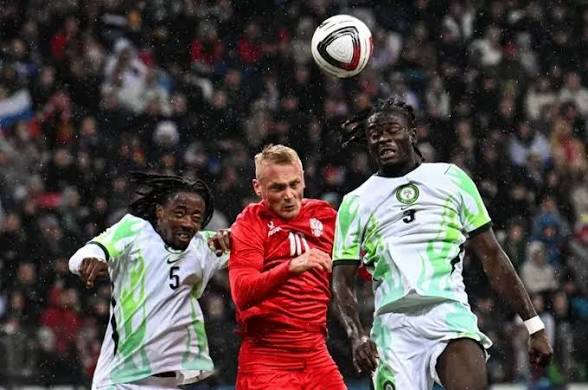
‘We did not work for it’: Amos Adamu blames NFF ladership for Nigeria’s World Cup failures
Former National Sports Commission Director-General Dr. Amos Adamu has blamed Nigeria’s failure to qualify for consecutive FIFA World Cup tournaments on poor planning, ineffective leadership and decisions that, in his view, have weakened the country’s football development.
Adamu, a former FIFA and CAF executive committee member, said Nigeria’s absence from the global showpiece should not be treated as an unfortunate accident, arguing that qualification requires deliberate preparation and effective management.
“Of course, Africa can rule the world if we do the right thing. It is just like Nigeria. We were not at the World Cup because we have not done the right things,” he said in an interview with Saturday Telegraph.
“If you work for it, you will be there. People come to me and say, ‘Nigeria is not at the World Cup.’ My response is that we did not work for it. If we worked for it, we’d qualify.”
The former football administrator questioned how Nigeria had fallen behind countries that previously would not have been regarded as major obstacles to the Super Eagles.
“Guinea-Bissau, for example. Is that what Nigerian football should be reduced to?” he asked.
Adamu said the problem went beyond individual players and coaches, pointing instead to the leadership decisions that shape the national team and the wider football system.
“I don’t like to talk too much about some of these things because many of the people involved are my boys. The problem is with the leadership and the decisions being made,” he added.
He also challenged the practice of retaining coaches who fail to achieve major objectives, arguing that national team appointments should be based on the capacity to deliver results.
“I am not looking for a coach who tries. I want a coach who can deliver results. I will give you what you need, but you must win. If you don’t win, I will fire you,” he said.
How Babangida Appointed Adamu Football Sole Administrator
Adamu also revisited the circumstances surrounding his appointment as sole administrator of Nigeria’s football governing body during the military administration of General Ibrahim Babangida.
He said the appointment followed a meeting at Dodan Barracks where officials were discussing the future of the Nigeria Football Association, now the Nigeria Football Federation (NFF).
According to Adamu, he challenged the proposals being considered and warned that implementing them would damage Nigerian football.
“I have listened to your discussions. If you implement all these decisions, you are taking Nigerian football back 20 years,” he recalled telling the gathering.
Adamu said Augustus Aikhomu, then Deputy Head of State, questioned whether he was suggesting that the officials had wasted their time.
“I’m not saying you have wasted your time, but the decisions you have taken will not take you anywhere,” Adamu said he replied.
He was subsequently asked to prepare a paper outlining an alternative approach. Adamu said he consulted professionals from several universities and completed the assignment within two days.
“When they met again, they realised that some of their earlier decisions were wrong. Subsequently, they dissolved the NFF and appointed me as sole administrator,” he said.
Adamu recalled that he made his conditions clear before accepting the responsibility, insisting that he needed the freedom to carry out his assignment without interference.
“I told them that if they made me sole administrator, I would not listen to anybody who wanted to interfere with my work. I said, ‘Allow me to do my job,’” he said.
He was then taken to meet Babangida, who, according to Adamu, assured him that he would have the authority required to carry out his responsibilities.
“He told me that I was the young man they wanted to give the responsibility to and that I should be allowed to do the job. He told me that only the president and vice president could stop me and that I should not listen to anybody else,” Adamu recalled.
“He then told me to go and write what was needed to qualify Nigeria for the World Cup. When I received that instruction, I knew I would qualify Nigeria.”
Adamu said Nigeria’s qualification campaign progressed quickly once the team began playing its matches, adding that he eventually asked to leave the position after achieving the objective for which he had been appointed.
“Once Nigeria qualified, I turned to them and said, ‘Please, can you remove me?’ I had achieved what I was brought in to achieve, so I wanted to return to my work,” he said.
Adamu Calls for Merit-Based National Team Selection
The former sports chief also argued that Nigeria needed stronger competition for places in its national teams.
He said selection should be based on objective assessments rather than recommendations from influential individuals.
“When I was there, people would come to me senators and others and say, ‘I have this boy. This is the boy’ I would say, ‘Bring him. Let the coach test him.’ If he was good, he stayed. If he was not, he left,” he said.
“I would not select a player simply because somebody recommended him. If they say a player is good, bring him and let him be tested. The same applies to boxing. If somebody says, ‘This is the best boxer,’ bring him. Let him box. If he is beaten, what else can anybody say?”
Adamu’s comments place leadership accountability, technical competence and merit-based selection at the centre of the debate over Nigeria’s football decline.
His argument is that World Cup qualification cannot be achieved through reputation or history alone but requires sustained preparation and decisions capable of producing results.


