
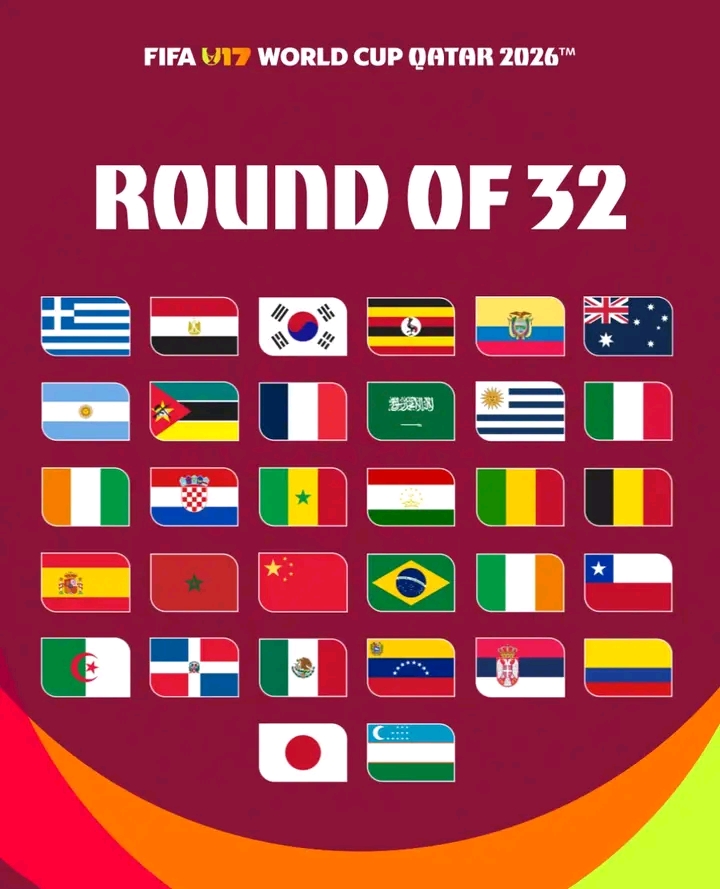
Africa makes strong statement as eight teams reach U-17 World Cup Round of 32
Africa has made a strong collective statement at the FIFA U-17 World Cup Qatar 2026, with eight of its 10 representatives advancing to the Round of 32 after a compelling group-stage campaign.
Mali, Egypt, Côte d’Ivoire, Senegal, Uganda, Morocco, Algeria and Mozambique have all secured places in the knockout phase, leaving Cameroon and Tanzania as the continent’s only eliminated representatives.
The impressive qualification rate means Africa will have eight teams competing in the first knockout round of the expanded 48-team tournament, providing another indication of the depth of emerging football talent across the continent.
Mali have been particularly impressive, finishing top of Group G with a perfect nine points from three matches. The West Africans completed their group campaign with a 2-0 victory over Vietnam, having already secured their knockout place before the final round of matches.
Egypt also progressed from Group A as runners-up behind Greece, collecting six points. The Pharaohs sealed their qualification with a convincing 4-1 victory over Panama, with Yousef Abdullah scoring twice before Khaled Mokhtar and Mohamed Gamal completed the victory.
Uganda produced one of the most emphatic results of the group stage, defeating New Caledonia 6-0 to finish second in Group B on four points. The result lifted the East Africans above Ecuador on overall goal difference and secured their place in the last 32.
Mozambique also progressed despite finishing third in Group C. Their 2-2 draw with Australia proved sufficient to secure one of the eight available places for the best third-placed teams, underlining the importance of the expanded tournament format.
Côte d’Ivoire joined the knockout field after beating Jamaica 3-1 to finish second in Group E with six points. Abdoul Doumbia opened the scoring before Koudougnon Drebo struck twice as the Ivorians secured their passage.
Senegal advanced as Group F runners-up with five points after drawing 1-1 with Tajikistan in their final group game. The result was enough to send the Young Teranga Lions through alongside group winners Croatia.
Morocco also survived a difficult final-day test, despite losing 2-0 to Spain. The North Africans finished second in Group H on four points, edging China on overall goal difference after both teams finished level on points.
Algeria completed the African contingent in the knockout phase by progressing from Group J, while Cameroon and Tanzania were unable to join their fellow representatives in the last 32.
For Cameroon, a difficult campaign ended without a point, while Tanzania finished third in Group I with one point. Their elimination means eight of Africa’s 10 representatives will continue their campaigns in Qatar.
The scale of Africa’s representation is particularly notable given the continent’s 10-team allocation at the tournament. The 2026 edition is the second 48-team U-17 World Cup, with the top two teams in each of the 12 groups and the eight best third-placed sides advancing to the Round of 32.
Africa’s progress also reflects the increasing competitiveness of youth football on the continent. Mali’s perfect group-stage record, Egypt’s six-point haul, Uganda’s emphatic qualification, Mozambique’s success as a third-placed side and the progression of Côte d’Ivoire, Senegal, Morocco and Algeria have collectively ensured that African representation remains substantial as the tournament enters its decisive phase.
With the group stage now complete, the focus shifts to the knockout rounds, where Africa’s eight survivors will face a new test against some of the strongest youth teams from Europe, South America, Asia and other confederations.


