
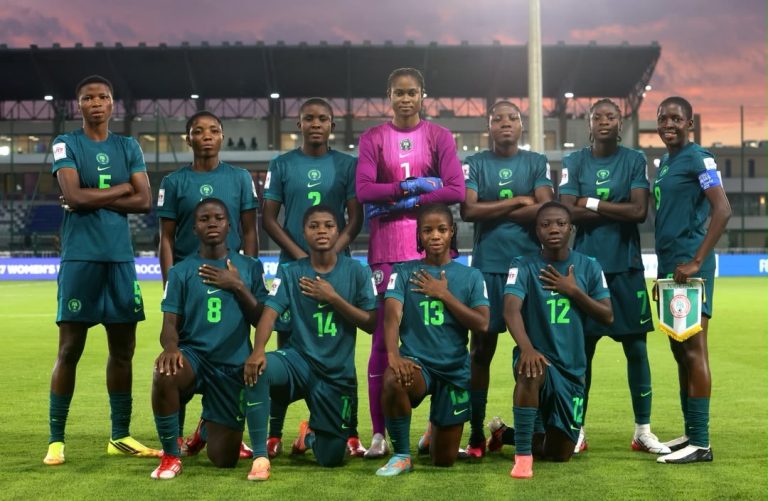
Flamingos victory over Korea DPR sends strong message to African women's football
Nigeria’s 3-1 victory over defending champions DPR Korea at the 2026 FIFA U-17 Women’s World Cup in Morocco was more than a ticket to the Round of 16. It ended an extraordinary unbeaten run and demonstrated that African youth teams can challenge the world’s most accomplished sides.
The Flamingos delivered a statement performance on Friday, October 23, bringing an end to DPR Korea’s 18-match unbeaten run in regulation time at the tournament, which dated back to November 14, 2018.
For Nigeria, the victory represented a defining moment in their campaign. For African women’s football, it provided another reason to believe in the continent’s ability to compete at the highest level.
DPR Korea arrived in Morocco with an impressive pedigree, having won consecutive titles in 2018 and 2024. The Asian side had also dominated their opening two Group B fixtures, scoring 12 goals and conceding just once in a 6-0 victory over Puerto Rico and a 6-1 demolition of Poland.
Those results underlined the defending champions’ quality, but Nigeria showed that reputation and past achievements do not determine the outcome of a football match.
The Flamingos approached the encounter with confidence and an attacking mentality, refusing to be intimidated by the champions’ formidable record.
Oluwakemi Adegbuyi opened the scoring in the 15th minute, using her individual skill to beat her marker before calmly finishing past goalkeeper Kim Son Gyong.
Nigeria doubled their advantage in the 38th minute when Oluebube Umejiaku converted a precise pass from Tosin Rafiu, giving the West Africans a deserved 2-0 lead at half-time.
The Nigerian side maintained its attacking intent after the restart, and Kanyinsola Yusuf made it 3-0 in the 56th minute with a superbly struck free-kick that left DPR Korea facing an uphill battle.
The defending champions reduced the deficit in the 82nd minute through Yu Jong-hyang, who converted a penalty. However, Nigeria remained composed to secure a memorable victory.
The result confirmed the Flamingos’ qualification for the Round of 16, with Nigeria finishing second in Group B on six points after losing 2-1 to Poland in their opening match and defeating Puerto Rico 2-0 in their second fixture.
The significance of Nigeria’s victory becomes clearer when viewed against DPR Korea’s history at the tournament.
According to FIFA records cited in reports surrounding the encounter, the North Koreans had gone 2,900 days without a defeat in regulation time at the FIFA U-17 Women’s World Cup. Their previous loss came against Germany on November 14, 2018, when they suffered a 4-1 defeat.
Since then, DPR Korea had lifted the trophy in 2018 and 2024, establishing themselves as one of the dominant forces in youth women's football.
Nigeria’s victory therefore represented more than three points in the group standings. It showed that even teams with exceptional records can be beaten when their opponents combine tactical discipline, technical ability, courage and a clear game plan.
The Flamingos did not need to match the champions’ reputation. They needed to execute their strategy, take their chances and remain composed under pressure. They did precisely that.
For African football, the message from Morocco is significant.
Young players across the continent often face opponents whose tournament records, international standing and recent results can appear intimidating before a match begins. Nigeria’s performance offers a reminder that such factors should not limit a team’s ambition.
The Flamingos demonstrated that African teams can compete against established powers by preparing thoroughly, trusting their abilities and maintaining discipline when the pressure rises.
However, one victory cannot resolve the wider challenges facing African women’s football. Differences in facilities, competition structures, player development, coaching resources and international exposure remain important obstacles.
What a result of this magnitude can do is strengthen the belief that African teams possess the potential to overcome elite opposition.
Nigeria’s achievement also presents an important lesson for football administrators across the continent: talent must be supported by sustained investment, competitive opportunities, quality coaching and clear pathways for young players to progress beyond youth tournaments.
A famous victory can inspire the next generation, but long-term development is what turns that inspiration into lasting progress.
The Flamingos’ triumph comes as African women’s football continues to pursue greater recognition and consistency on the global stage.
For other African representatives and aspiring youth teams, Nigeria’s achievement provides encouragement without creating unrealistic expectations. Every team faces different opponents, tournament circumstances and challenges.
The lesson is not that victories over defending champions should be expected in every competition, but that African teams must approach such contests with ambition rather than fear.
Nigeria have also demonstrated the importance of resilience in tournament football. After losing their opening match against Poland, the Flamingos reassessed their approach, recovered with a victory over Puerto Rico and then produced their most impressive performance against DPR Korea.
Their response underlines the value of learning quickly, adapting tactically and delivering when the stakes are highest.
A disappointing result can derail a campaign if confidence disappears. The Flamingos instead used their opening defeat as motivation to improve, eventually securing consecutive victories to advance to the knockout stage.
Head coach Akeem Busari deserves credit for preparing his players to confront an opponent whose pace, movement and attacking quality had troubled other teams.
Following the match, Busari explained that Nigeria had worked to disrupt DPR Korea’s preferred patterns of play and maintain a numerical advantage in key defensive areas.
The coach acknowledged the challenge of facing a team that had scored 12 goals in its opening two matches, particularly after Nigeria’s own opening defeat to Poland.
The Flamingos responded with a combination of defensive organisation and attacking intent. They limited the champions’ opportunities while taking advantage of the openings that came their way.
The three goals also highlighted different aspects of Nigeria’s attacking quality: Adegbuyi’s individual brilliance, Umejiaku’s composed finishing and Yusuf’s excellent free-kick.
That variety will be valuable in the knockout stage, where every opponent presents a different tactical challenge and a single defeat can end a team's campaign.
Nigeria’s achievement deserves celebration, but the next challenge is to turn the victory into a foundation for further progress.
The Round of 16 will demand the same intensity, discipline and composure that enabled the Flamingos to overcome DPR Korea. The players must ensure that the excitement surrounding their historic victory does not distract them from the task ahead.
For the rest of Africa, the significance of the result should extend beyond Nigeria’s immediate campaign. It should encourage stronger investment in youth development, greater support for women’s football and a sustained commitment to building teams capable of competing consistently at international level.
The Flamingos have already secured their place in the knockout stage and ended one of the competition’s most remarkable unbeaten runs. How far they progress from here will determine the ultimate success of their campaign.
Yet the wider message has already been delivered.
DPR Korea arrived in Morocco as defending champions with an exceptional record. Nigeria confronted them with courage, tactical discipline and the belief that they could win.
The Flamingos emerged victorious by 3-1, giving Nigeria a memorable result and African women’s football another reason to believe in its potential on the world stage.


