
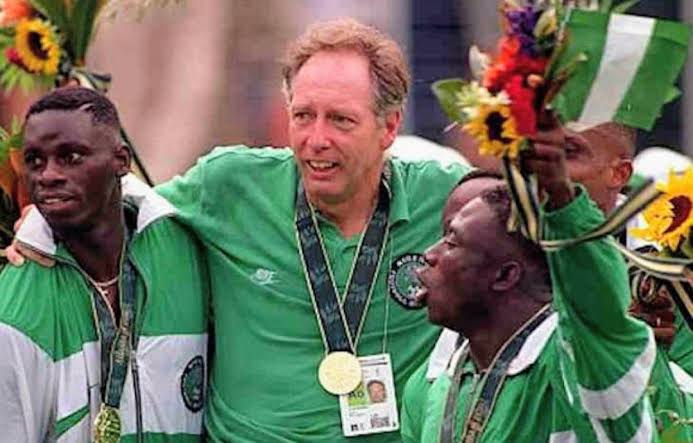
Jo Bonfrère: I’m still waiting for my 1996 Olympic Gold reward
Former Nigeria coach Jo Bonfrère has claimed that he has yet to receive his reward or Olympic gold medal for leading Nigeria to victory in the men’s football event at the 1996 Atlanta Olympic Games, 30 years after the historic achievement.
The 80-year-old Dutchman made the disclosure during an interview with CreativeLordTV in Ebonyi State, where he attended the opening of Chief Agueze’s country home on Saturday. His remarks have renewed attention on the treatment of the coaches and officials who contributed to one of Nigerian football’s greatest moments.
Speaking through an interpreter, Bonfrère said he had never received the gold medal awarded for the triumph, leaving him unable to say what the medal looked like.
“I have never seen the gold. That’s the problem, so I don’t know how it looks. I don’t know how the gold medal looks because I have never received it,” he said.
The interpreter added that, according to Bonfrère, the players and other officials had received their rewards, while the former coach remained without his own package three decades later.
The latest allegation follows an earlier interview with The PUNCH in August, during which Bonfrère claimed that his Olympic gold medal had been stolen while it was in the custody of a team official. He also maintained that he had not received the government reward reportedly given to members of the victorious team.
Bonfrère further revisited an alleged disagreement with a minister over player selection ahead of the Atlanta tournament. According to his account, the minister repeatedly pressured him to include certain players, but the coach insisted on selecting the squad he believed could win the competition. The claim has not been independently established in the report.
Bonfrère guided a talented Nigerian team featuring Nwankwo Kanu, Austin “Jay-Jay” Okocha, Daniel Amokachi, Taribo West, Celestine Babayaro, Garba Lawal and Emmanuel Amuneke to Olympic glory.
Nigeria’s journey to the gold medal included a memorable 4-3 extra-time victory over Brazil in the semi-final, before the team came from behind to defeat Argentina 3-2 in the final at Sanford Stadium in Georgia.
The triumph made Nigeria the first African country to win Olympic gold in men’s football and cemented the team’s place in the history of the sport.
The Atlanta victory remains one of the defining achievements of Nigerian football, celebrated for the team’s resilience, attacking quality and ability to overcome two of the tournament’s strongest sides.
Bonfrère’s latest comments raise questions about whether the recognition and rewards promised after such a landmark achievement were delivered to everyone involved.
However, his account remains an allegation that would require confirmation from the relevant government authorities and football administrators.
The former coach said his attempts to obtain recognition from the authorities had produced little response, but he remained hopeful that his contribution would eventually be acknowledged.
Nearly three decades after the Olympic triumph, the dispute serves as a reminder that celebrating sporting success also involves recognising the coaches, players and officials whose work helped make it possible


