
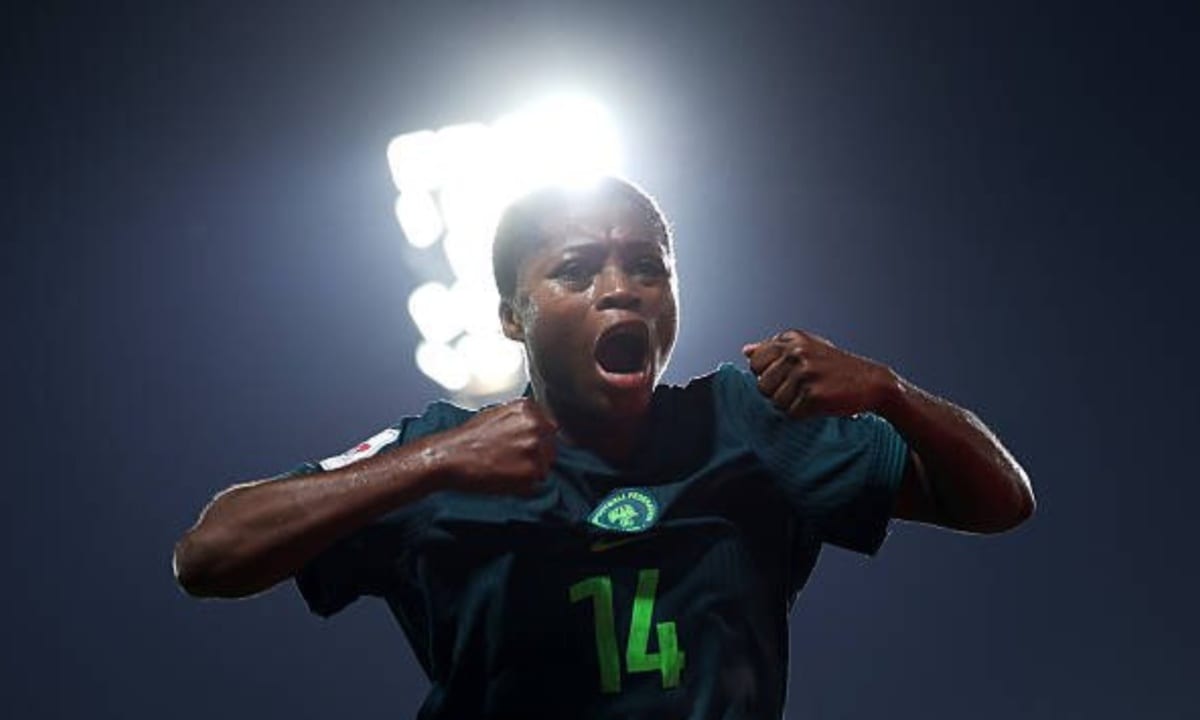
Nigeria’s next generation star? The story of 16-year-old hot prospect Kemi Adegbuyi
By Samuel Ahmadu
At 16, Oluwakemi Adegbuyi is already living a football story that many players spend years trying to write.
She has been named Player of the Season in the 2025/26 Nigeria Women’s Football League (NWFL) Premiership, made a decisive impact in the Super Six playoffs with Robo Queens, won the Player of the Tournament award at the WAFU-B CAF Women’s Champions League qualifiers while representing Edo Queens and collected another best-player honour with Nigeria’s U-17 women’s team, the Flamingos.
Her rise has continued on the international stage, culminating in Nigeria’s historic triumph at the 2026 FIFA U-17 Women’s World Cup in Morocco. Adegbuyi contributed nine goals across the qualifying campaign and the World Cup journey, underlining her importance to the Flamingos’ successful run. At the global tournament, she scored twice and provided an assist in Nigeria’s opening two group matches, including an important goal against defending champions North Korea.
For a teenage player still navigating secondary-school education, these are extraordinary milestones. Her nine-goal contribution to Nigeria’s journey to becoming world champions adds another remarkable chapter to an already impressive rise. But Adegbuyi’s story offers more than statistics and individual honours. The people closest to her are united on what must come next: patience, discipline, education and an environment that continues to develop the footballer behind the headlines.
A talent that began with movement
Long before the trophies and television appearances, Adegbuyi was a little girl whose energy caught the attention of people around her.
Her father, Adegbuyi Ifagbenga Adeleke, recalls that the family began noticing her unusual enthusiasm for running when she was about eight or nine years old.
“When we started seeing Kemi Adegbuyi on the streets running around, we observed that whenever she sees people playing football, especially when she and her mother move together or go on an errand, she will keep running,” he told SavidNews.com.
“Instead of walking, she always ran. Within a twinkle of an eye, she ran for an errand and returned quickly. That was how people started noticing her potentials that she would like sports.”
What initially appeared to be a child’s boundless energy gradually became something the family could no longer ignore. Neighbours and local coaches began discussing her prospects, encouraging her parents to provide an opportunity for her to develop.
Adeleke said the family considered the advice seriously and decided that her talent deserved a structured football environment.
“Our neighbours and coaches in the neighbourhood consulted us on her potentials to hasten her going to a football club, especially FC Robo Queens,” he explained.
“He had meetings with the mother on her issue. We agreed that once we see a young child with a certain talent and potentials, parents should help. That was why we quickly took her to FC Robo Queens to start from there.”
Adegbuyi joined FC Robo Queens at nine, beginning a journey that would take her from neighbourhood football to Nigeria’s leading women’s league and eventually to the FIFA U-17 Women’s World Cup.
The decision was not a guarantee of success. It was, however, the first important investment in a talent that would need years of training, competition, discipline and support to mature.
The FC Robo Queens foundation
For Emmanuel Osahon, the coach of FC Robo Queens, Adegbuyi’s progress is the result of a long development process rather than a sudden discovery.
Osahon is quick to correct the suggestion that he alone discovered the teenager. He said her parents brought her to him when she was still very young, with a connection to another local coach, Lekan, in Ijebu-Ode helping to bring the family to the club.
“I was not the one that discovered Kemi Adegbuyi. The parents brought her to me,” Osahon told SavidNews.com.
He remembers a player whose natural qualities were evident early, particularly her speed, willingness to learn and ability to trouble defenders in front of goal.
“Kemi is quick to learn. She has good speed and is unpredictable in front of goal. There are a lot of qualities with her from childhood,” he said.
Those attributes would eventually become important elements of her game. But Osahon understood that the teenager needed exposure beyond routine training. He took her to youth football gatherings and other development opportunities, including the Asisat Oshoala Academy, to help her experience different environments and playing surfaces.
“I even took her to Betsy Obaseki Tournament some years back to make her get used to the game because I knew she was going to be great,” he said.
Her experience at the Asisat Oshoala Academy also helped the coach assess how she could perform in different conditions.
At FC Robo Queens, he explained, the players train on a sandy pitch, while the academy offered access to a synthetic surface. Seeing Adegbuyi in that environment reinforced his belief that she could progress with the right support.
“I saw her performance and noticed that if she is given good attention, she is going to perform, so I am not surprised,” Osahon added.
The season that announced her arrival
Adegbuyi’s emergence became impossible to ignore during the 2025/26 NWFL Premiership season with FC Robo Queens.
She finished the campaign with 11 goals and was named the league’s Player of the Season, earning one of the most significant individual awards available in Nigerian women’s domestic football.
Her contribution extended into the Super Six playoffs, where she scored three goals on her debut in the competition’s final phase. Her performances demonstrated that she could make an impact not only during the regular season but also when the country’s leading teams assembled to compete for the championship.
For a player of her age, the award carried particular significance. She was not merely a promising prospect being discussed for the future, as she had already delivered a body of work that placed her among the outstanding performers in the senior domestic game.
Yet the achievement was not built around goals alone. Her pace, direct attacking approach and ability to create problems for opposing defenders made her a threat that teams had to account for.
Osahon believes Adegbuyi must continue to develop the details of her game.
“At 16, she needs to learn to score more goals, position herself and take her chances,” he said.
“When it comes to speed, she is very quick, which you cannot take away from her. She needs to take her time and be patient to learn.”
From domestic star to continental champion
Adegbuyi’s next major test came with Edo Queens, where she contributed to the Nigerian club’s successful campaign at the 2026 WAFU-B CAF Women’s Champions League qualifiers.
The teenager was named Player of the Tournament after helping Edo Queens win the regional competition and secure qualification for the 2026/27 CAF Women’s Champions League.
The honour placed her achievements in a broader context. She had already been recognised as the best player in Nigeria’s domestic league; now she had distinguished herself in a competition involving leading clubs from across West Africa.
Her performances included important contributions in the group stage, with goals against ASEC Mimosas among the standout moments of Edo Queens’ campaign.
The Nigerian champions fought through the tournament and defeated Ghanaian champions Ampem Darkoa Ladies in the final, prevailing on penalties after a 2-2 draw.
Adegbuyi’s individual award was evidence of her influence in that run, but the experience also offered an opportunity to learn within a senior team pursuing continental success.
For Osahon, however, the priority remained the same even as the accolades accumulated.
He said Adegbuyi returned from the WAFU-B campaign to prepare for her West African Examinations Council (WAEC) examinations, an indication of the balance her family and club are trying to maintain.
“After the WAFU-B Women’s Champions League with Edo Queens, she had to come back home to write her WAEC because she is very intelligent,” he said.
“I want her to go to school like I agreed with the parents that she will go to school. She is not in a hurry to make it as a young girl.”
That approach is central to the story of Adegbuyi at 16. The ambition is to help her succeed in football without forcing her to sacrifice the education and personal development that can support her beyond the pitch.
Busari’s first impression, Her speed, courage and a goal in mind
Nigeria U-17 head coach Hakeem Busari first saw Adegbuyi in Lagos in 2019, when she was still a child.
What caught his attention was not simply that she could run quickly. He noticed how she approached the game, how she carried the ball and her willingness to take risks in attacking situations.
“The very first day I saw her in 2019 in Lagos, I liked her quickness, both on and off the ball. Her approach,” Busari told SavidNews.com.
“Despite her age, she had quick dribbling skills. She really wanted to take risks at some time. Always, her eyes were towards the goal. Those are the things that really encouraged me to go for her so that I can add more value to her playing style.”
The coach’s description captures the ingredients that make Adegbuyi an exciting attacking prospect. Her speed gives her the ability to attack space, her dribbling can unsettle opponents and her instinct to look towards goal provides an attacking purpose to her movement.
“One of the things that attracted me when I saw her was her quick attacking strength towards goal, good one-versus-one ability,” he said.
“There have been a lot of improvements before she won the WAFU-B and the NWFL Premiership Most Valuable Player awards. I think at this level she is just starting.”
That final observation is particularly important. The awards have confirmed her promise, but they do not mark the end of her development. In Busari’s view, Adegbuyi has only begun to explore what she can become.
The technical details behind the goals
A player’s highlights often show the final action: a defender beaten, a shot taken or the ball crossing the goal line. Coaches, however, spend much of their time working on the movements and decisions that happen before that moment.
Busari is focused on improving Adegbuyi’s understanding of the game inside and around the penalty area.
“All we need to do is give her more game understanding, where she needs to carry, when to drop the ball and, when she gets to the box, her composure,” he explained.
He is also working on her finishing choices, including how to attack the near post when the situation demands it and how to exploit the blind side of a defender when the ball is away from her.
“Using the first post when the ball is more on her and using the blind side when the ball is off her, bending the ball to beat the goalkeeper. these are the major things that we are really working on presently,” he said.
These are not minor adjustments. At higher levels, defenders close space faster, goalkeepers read attackers more efficiently and opportunities can disappear within a second. An attacker who learns to anticipate movement, vary her finishing and make the right decision under pressure can become more effective without needing to rely solely on speed.
Busari also believes that Adegbuyi must improve her ability to compete physically.
“Adaptation at this level has been a little bit tedious, but we tend to have more patience with her. When we talk about physical strength, those are what we need to put her through,” he said.
He explained that Adegbuyi initially played behind the striker, Opeyemi Ajakaye, before he moved her towards the flanks in the Flamingos setup. The adjustment allowed the team to make better use of her speed and flair.
“Coming to the U-17 team, I tried to push her to the flanks where she would be able to have her flair. Her speed also shows for the team,” Busari said.
“Ability to release and have a return pass inside the box are advantages which have been working for the team. That has also improved her knowledge about the game.”
His work with the teenager includes improving her duels on the ground and in the air, encouraging quicker runs into space and helping her avoid unnecessary physical contests when her movement can provide a more effective route to goal.
“The specific area she needs to work on is her duel on the ball, both on the ground and in the air, and her ability to run into space quickly,” he said.
“Trying to use more of the second post when she gets composed in the box, these are the strengths that can increase her goal-scoring chances and vision in the box.”
A World Cup moment that meant more than a goal
The 2026 FIFA U-17 Women’s World Cup in Morocco provided Adegbuyi with another platform to test herself against international opposition, and she made the most of the opportunity.
Her contribution across the qualifying campaign and the World Cup amounted to nine goals, making her one of the important attacking figures in Nigeria’s journey to the title. Her goals at the tournament, including an effort against defending champions North Korea, reflected the attacking instinct that had been evident throughout her development.
For Adegbuyi, scoring at the World Cup was especially meaningful, representing a personal milestone after years of development at club and national-team level.
“I feel very blessed and grateful to God for how far I have come at just 16,” she told SavidNews.com, in Rabat.
“This achievement really means a lot to me, especially my first goal at the U-17 FIFA Women’s World Cup. This moment really means a lot to me. I am grateful for the support from my teammates and coaches. I also try to stay humble and keep improving on myself.”
The statement is modest, but it speaks to the significance of the moment. For a young footballer, scoring at a FIFA World Cup is not just another entry on a statistics sheet. It is the result of years of training, selection, competition and the opportunity to represent her country on a global stage.
Asked about her feelings when stepping onto the pitch, Adegbuyi said she was excited but focused on the task.
“I was honestly happy, excited. Stepping into the pitch, I was focused, determined and believed in my abilities,” she said.
She also credited the collective effort behind her scoring form.
“The secret behind my goal-scoring form is hard work, consistency and the support of my teammates and coaches.”
Adegbuyi’s role in the Flamingos attack was therefore both individual and collective. Her pace and eye for goal made her an important attacking option, but her contribution also depended on how effectively she combined with teammates and understood the team’s broader attacking plan.
The nine goals across the qualifying campaign and World Cup journey are an impressive return for a 16-year-old, but they also reflect the collective work of a team that went on to make history by winning the global competition.
The family behind the footballer
For her father, seeing Adegbuyi’s progress has brought pride and gratitude.
Adeleke recalls the excitement among relatives and neighbours when they began seeing her on television. The family also received calls after learning that she had won the NWFL Premiership Player of the Season award.
“When my neighbours saw her on television, they were all happy. We received lots of phone calls about Kemi,” he said.
“We called the coaches and they informed us that she won NWFL Premiership Most Valuable Player. We were happy as a family. We pray that God continues to help her and take her to higher places.”
The family’s involvement has not ended with taking her to a club. Adeleke said he and Adegbuyi’s mother regularly call her, offer advice and speak with her club coach about monitoring her progress.
“We are trying, calling her every time, myself and her mother. We advise her and call her coach, Emmanuel Osahon, every time to help monitor her. We want Kemi to be successful like those ahead of her,” he said.
He describes his daughter as quiet and introverted, saying the club has never contacted the family over misconduct.
“Kemi doesn’t talk much. She is an introvert and a gentle girl from the onset,” he said.
“Since she has been with FC Robo Queens, they have never called us for any misconduct on her part. That was her behaviour with us before joining the team.”
His hopes for her future are clear. He wants her to follow the path of Nigerian stars who have gone on to represent the Super Falcons and establish themselves internationally.
“We encourage her and pray for her. Kemi is a very good child and loved by everyone. We pray that God takes her to higher places like Asisat Oshoala, Rasheedat Ajibade and others who passed through FC Robo Queens,” he said.
The references to Oshoala and Ajibade are aspirational, not a suggestion that Adegbuyi’s career will necessarily follow the same trajectory. Each player has a different path, and the teenager still has important stages of development ahead.
Sports journalist and talent promoter Victor Ademola said he first noticed Adegbuyi’s exceptional talent at 14 while watching FC Robo Queens train in the NWFL, with her movement, discipline and confidence immediately standing out.
“With achievements of this level at such a young age, her story needs to be told in a structured and intentional way, so that in the years ahead, people can clearly see how it all began,” Ademola said.
“While her goals and awards matter, the aim is to help fans understand the person behind the performances and to give her the experience and confidence to tell her own story as her profile continues to grow,” he explained.
He added that his long-term vision is for fans to remember Adegbuyi’s humble beginnings, resilience and development, saying: “She is an exceptional talent, and the goal is to document and present her journey properly from the start, so her story remains clear, authentic, and something people can look back on with pride as she continues to grow.”
The danger of early fame
With multiple individual honours already attached to her name, Adegbuyi is likely to attract greater attention from supporters, clubs and observers of women’s football.
That attention can create opportunities, but it can also bring pressure before a young player has fully developed the emotional and professional tools to manage it.
Both Busari and Osahon have made the same point: she must not allow the excitement surrounding her achievements to become complacency.
“She should not let the euphoria of this current fame and form get into her head. Me and the father use to tell her,” Osahon said.
“I need to teach her lots of things because she is not my first product.”
Busari is equally clear that the teenager should see her current success as the beginning of a process, not evidence that she has already arrived.
“For a player of her calibre, we could see that she has passion and enjoys the game,” he said.
“We tend to advise her more as well, looking up to the Super Falcons as one of the big opportunities for her in her career. She should not look at it as if she is there already. She is still progressing in terms of learning.”
The warning is not intended to diminish her achievements. It is a way of protecting them.
A young player who wins awards early needs continued coaching, appropriate competition, good advice and the freedom to make mistakes while learning. Development is rarely a straight line, and the expectations placed on teenagers can become counterproductive when every performance is treated as a final verdict on their future.
For Adegbuyi, the priority is to keep improving, remain grounded and allow her football to develop at the right pace.
Education as part of the game
One of the most significant aspects of Adegbuyi’s story is the insistence from her family and club that education remains a priority.
Osahon said the club had agreed with her parents that she would continue schooling while developing her football career. Her return to prepare for WAEC after the WAFU-B campaign was part of that arrangement.
As a developer of Oshoala and Ajibade, the Robo coach believes she has time to grow and that the search for opportunities must not turn into a rush to make money or move abroad before she is ready.
“This is a time that we are producing girls of her age for the national team. She has a lot of things to learn. With that, we are not quick or in a hurry. She and her family are not quick or in a hurry,” he said.
“We are looking for the opportunity for her to balance the footballing career with education. That is the kind of opportunity we are waiting for.”
Busari also regards education as an asset in football, helping a player develop her understanding and make better decisions on and off the pitch.
“She is still a young lass who is in secondary school. She must take education as one of the major strengths which will open her mind into the game,” he said.
“The game education is more of an advantage as she progresses in her career.”
A dream bigger than the next award
For Adegbuyi, the ambition extends far beyond the achievements she has already collected.
She wants to become one of the biggest footballers in the world and to represent Nigeria at senior level.
“My biggest dream is to become one of the biggest footballers in the world. To be known in Nigeria, Africa and the whole world,” she said.
“I will also be honoured to represent my country at senior level. For now, I will keep staying humble, keep improving on myself and being consistent.”
The next phase of her career will depend on how she responds to new challenges, how effectively she learns from setbacks and whether the people around her can provide the right balance of opportunity and protection.
Busari said the responsibility includes counselling her, giving her a development plan and monitoring both her football and school commitments.
“Trying to really give her a template of how development of football is and letting her not allow whatever is coming to her now to take her unaware,” he said.
“She should put her head up and not allow complacency at this level. She should be open to more learning on and off the ball. We need to monitor and give her programmes. Monitor her school programmes as well.”
The objective, he added, is to ensure that the progress she has made at 16 becomes the foundation for a longer and more sustainable career.
The journey is only beginning
Adegbuyi’s rise has been remarkable in its speed and breadth. She has succeeded in Nigeria’s senior women’s league, won recognition in West African club football, collected individual honours at WAFU-B level and played a significant role in the Flamingos’ historic FIFA U-17 Women’s World Cup triumph.
Her nine-goal contribution from the qualifying campaign through the global tournament provides a striking measure of her influence on Nigeria’s journey to the title. At 16, she has already demonstrated that she can deliver on domestic, regional and international stages.
Those milestones have made her one of the young Nigerian footballers to watch.
But she does not need to carry the burden of becoming the next Oshoala or Ajibade. She needs the opportunity to become the best version of herself, with the right coaching, education, support and time.
The awards have announced her arrival. The nine goals have underlined her contribution to a historic campaign. The work ahead will determine how far she goes.
And if the people guiding her have their way, the story of Adegbuyi will not be remembered only for what she achieved as a teenager, but for the footballer she grows into in the years to come.


