
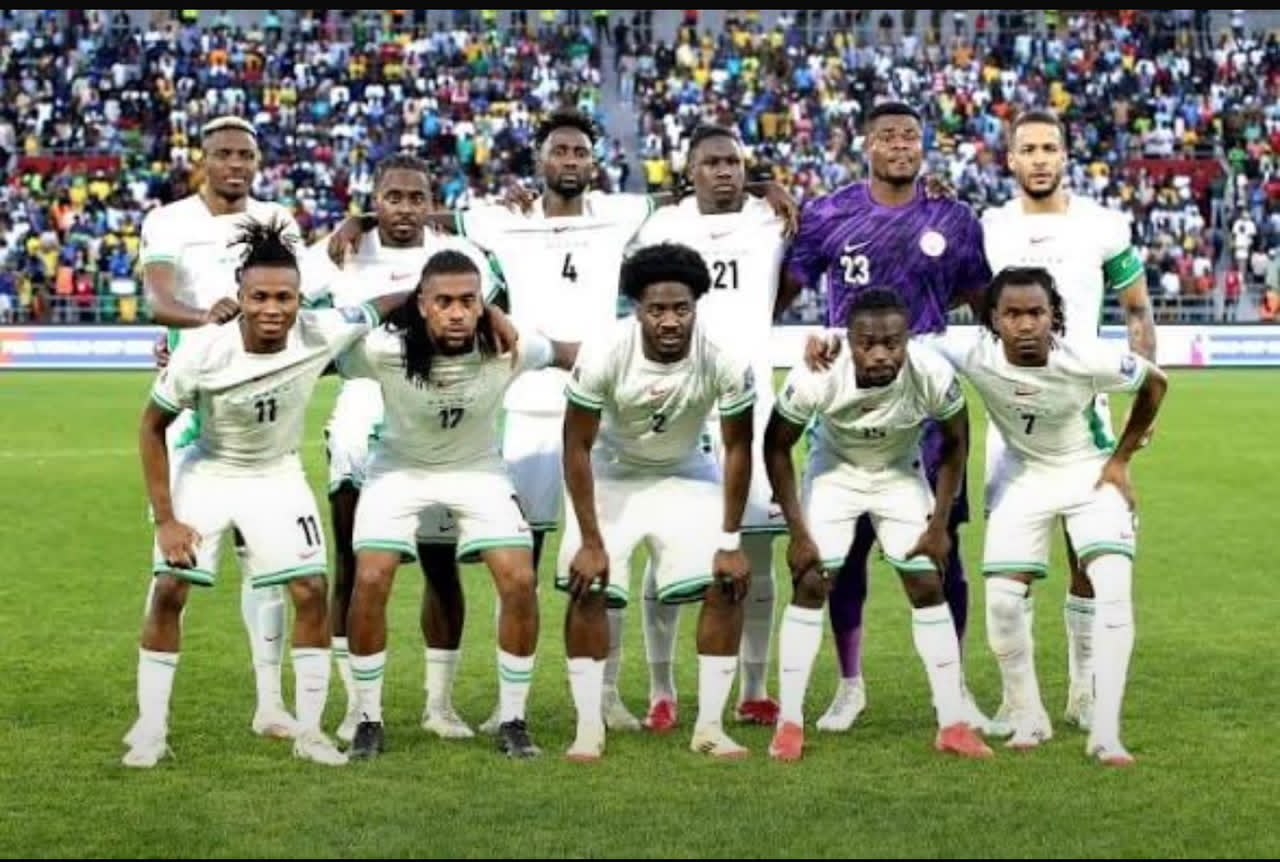
Super Eagles defeat: Where does the responsibility lie?
By Ruth Dave Williams
Blaming and judging are easy mental shortcuts. Critical thinking is harder. In football, especially in Nigeria, we have become remarkably skilled at finding a convenient scapegoat whenever the Super Eagles disappoint.
The coach is blamed.
The players are blamed.
The Nigeria Football Federation is blamed.
Sometimes, even the goalkeeper is left carrying the burden of an entire team’s failure.
But I have a question:
Why does the National Sports Commission so often escape the conversation?
I have watched Nigerian football for decades, and I honestly cannot remember seeing my darling Super Eagles so comprehensively bullied, overpowered and outplayed by an African opponent as they were against Guinea-Bissau.
It was not simply the result that was disturbing. It was the manner of the defeat.
The midfield was overrun. The team struggled to impose itself. Our attacking threat was largely neutralised, while the opposition repeatedly found opportunities that could have produced an even more embarrassing scoreline.
At several points, it looked as though we were watching a team without answers. So, naturally, Nigerians are asking: Who should take responsibility?
The players?
The coach?
The NFF?
Or should we also be asking questions of the National Sports Commission and its leadership?
WHY DOES THE NFF ALWAYS CARRY THE CAN?
The NFF has already paid a significant institutional price for the failures of Nigeria’s national teams.
Following Nigeria’s failure to qualify for the 2026 FIFA World Cup and the Super Falcons’ failure to qualify for the 2027 FIFA Women’s World Cup, the NFF leadership eventually departed amid intense criticism.
Yet the wider conversation about Nigerian football administration seems to stop at the NFF.
That deserves scrutiny.
The National Sports Commission is not merely a distant observer of Nigerian sport. Its leadership has become increasingly involved in decisions concerning the national teams and the broader direction of Nigerian football.
They hire coaches
They determine when to pay allowances.
When an institution exercises influence over a system, it is reasonable to ask how that influence is being exercised, and what responsibility accompanies it.
This is not about shifting blame from the NFF to the NSC. It is about broadening accountability to include everyone who has a meaningful role in the system.
THE COACH CANNOT BE THE ENTIRE STORY
Of course, the coach must answer questions.
Tactics, team selection, preparation, substitutions and the team's organisation on the pitch are legitimate areas for scrutiny.
The players must also accept responsibility. Wearing the Super Eagles shirt carries an obligation to demonstrate discipline, commitment, intelligence and pride.
But Nigerian football has changed coaches, players and formations repeatedly without eliminating many of the problems that continue to plague the national teams.
Perhaps, therefore, we should stop treating every disappointing result as an isolated coaching failure.
The deeper question is:
What kind of football system are we building, and who is responsible for making it work?
That question takes us beyond the touchline. It takes us into administration, preparation, player development, technical structures, logistics, sports science, scouting and governance.
SO, WHY SHEHU DIKKO?
I am asking this question about Mallam Shehu Dikko not because I believe he personally caused the defeat.
That would be simplistic.
Football matches are lost by teams, and individual performances, tactics, preparation and the quality of the opposition all matter.
My point is different.
If we are prepared to demand accountability from the NFF, why should the NSC be treated as untouchable?
If the Commission has a role in shaping Nigerian football, then Nigerians have every right to examine that role.
What decisions has it made?
What structures is it putting in place?
What standards is it demanding?
And, most importantly, what measurable difference is its intervention making to the quality and competitiveness of our national teams?
These are legitimate questions.
They should not be interpreted as an attack on any individual.
NIGERIA NEEDS ANSWERS, NOT ANOTHER SCAPEGOAT
The danger is that we repeat the same cycle after every disappointment:
Lose. Blame the coach. Blame the NFF. Demand resignations. Appoint another coach. Start again.
Then we act surprised when the same structural problems return.
Nigeria does not lack football talent. What we have yet to build consistently is a football system capable of converting that talent into sustained excellence.
That requires more than changing coaches.
It requires institutional responsibility from everybody who has a seat at the table.
So after watching the Super Eagles surrender control so completely, I am less interested in finding another scapegoat than in asking a more uncomfortable question:
If the NFF must answer for the state of Nigerian football, who answers for the National Sports Commission?
And if the NSC now has a greater voice in the affairs of Nigerian football, then it must also be prepared to accept a greater share of the scrutiny.
Influence without accountability is not reform. It is merely a change of who gets to make the decisions.
That is the conversation Nigerian football needs now.
Ruth Dave Williams is a passionate freelance footballer writer. She lives in Abuja


