
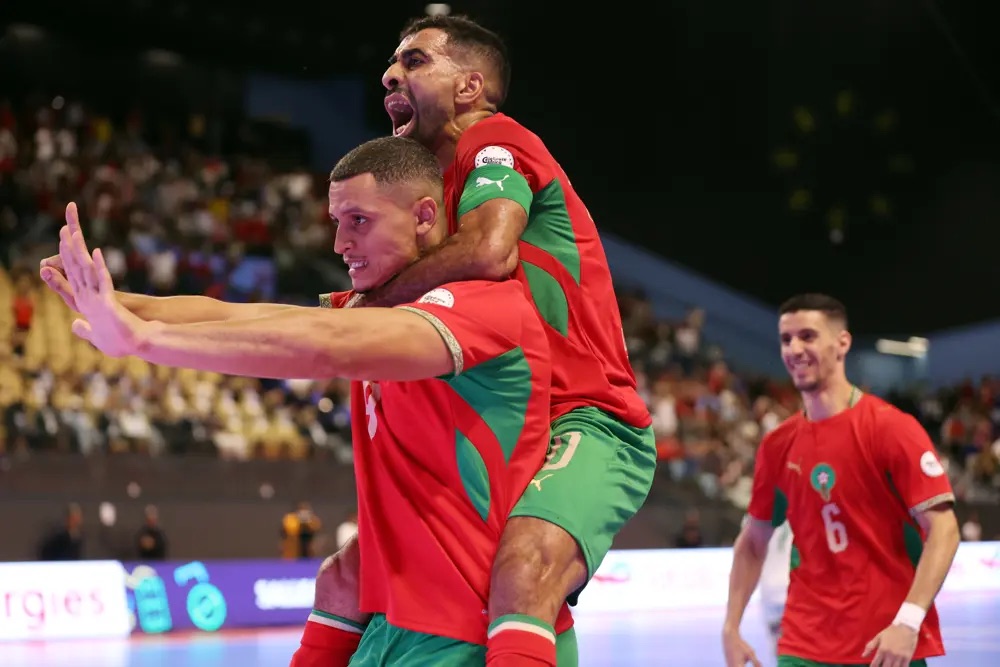
Morocco’s Futsal Revolution: Inside the Atlas Lions’ quest for another African crown in Rabat
By Samuel Ahmadu in Rabat
In the fast-moving world of futsal, where space disappears in a split second and a single mistake can change a match, Morocco have built a reputation as Africa’s standard-setters. At the 2026 TotalEnergies CAF Futsal Africa Cup of Nations, the Atlas Lions are at home, defending their crown and pursuing a fourth consecutive continental title.
The competition, taking place in Rabat from October 12 to 21, brings together eight national teams: Morocco, Algeria, Libya, Zambia, Egypt, Angola, Mozambique and Tanzania. Beyond the continental trophy, the stakes are global, with the top three finishers earning qualification for the 2028 FIFA Futsal World Cup.
For Morocco, however, this is about more than defending a title. It is another opportunity to demonstrate that the country’s rise in futsal is not a temporary golden period, but the result of sustained investment, coaching continuity, tactical discipline and a clear competitive identity.
From challengers to continental champions
Morocco’s modern futsal story has been shaped by steady progress. The national team won its first African title in 2016, retained it in 2020 and completed a three-title run in 2024, when it defeated Angola 5-1 in the final on home soil. Those victories placed Morocco alongside Egypt among the competition’s most successful nations, with three titles each before the 2026 edition.
The transformation has not happened overnight. Head coach Hicham Dguig has led the national side since 2010, providing continuity across several generations of players. Under his leadership, Morocco qualified for the FIFA Futsal World Cup for the first time in 2012 before claiming its maiden continental championship four years later.
That continuity matters in futsal, a sport requiring rapid decisions, rehearsed movement and an understanding of how teammates react under pressure. Players must be comfortable changing positions, pressing collectively, defending in compact spaces and switching from attack to defence almost instantly.
Morocco’s recent success reflects the value of building those habits over time rather than relying solely on individual talent.
The Hicham Dguig blueprint
Dguig has been central to Morocco’s development into a team capable of competing beyond Africa. His long tenure has allowed the national side to develop a recognisable approach, combining aggressive pressure, technical quality and swift combinations in tight areas.
The coach’s task in 2026 is not simply to motivate a team that has already won the competition three times in succession. It is to ensure that success does not become a source of complacency.
Opponents now approach Morocco with a clear understanding of the threat posed by the hosts. They know the defending champions can punish loose possession, exploit defensive gaps and turn a brief spell of pressure into multiple scoring opportunities.
Maintaining standards, therefore, requires constant adjustment. Morocco must remain tactically flexible while preserving the confidence and attacking rhythm that have helped define their recent dominance.
El Mesrar and the strength of the collective
Captain Soufiane El Mesrar remains one of the central figures in Morocco’s futsal project. A key member of the 2024 championship-winning side, he has also demonstrated his ability to perform on the world stage, scoring twice in Morocco’s 6-3 victory over Panama at the 2024 FIFA Futsal World Cup.
His influence extends beyond finishing chances. In a sport where possession can change hands several times within seconds, leadership, movement and the ability to recognise opportunities early are crucial. Experienced players help organise the team during difficult spells and ensure that tactical instructions remain clear amid the intensity of competition.
Yet Morocco’s campaign has also shown that its attacking threat is not dependent on one individual.
In the group stage, Idriss Raiss El Fenni scored four times in a 7-0 victory over Zambia, while El Mesrar produced a hat-trick in the subsequent 6-0 win over Libya. Othmane El Idrissi also contributed a brace against Libya, highlighting the variety of scoring options available to Dguig.
That distribution of goals makes Morocco difficult to contain. Opponents cannot focus exclusively on one forward without leaving space for another player to exploit.
Rabat turns into Morocco’s stage
Playing at home offers Morocco familiarity with the venues, the support of local fans and the psychological lift that comes from competing before a supportive crowd. But home advantage also brings pressure: expectations rise when a defending champion is playing in front of its own supporters.
The tournament is being staged at the Moulay Abdellah Sports Hall and the Yassine Sports Hall in Rabat. The two venues are hosting 16 matches across the ten-day competition.
Rabat’s role is significant because futsal remains less visible than the traditional outdoor game in many football markets. A successful tournament can bring the indoor version of football closer to new audiences, particularly young players attracted by its speed, technical demands and constant involvement.
For Morocco, hosting the championship is also an opportunity to showcase its capacity to stage major football events while placing futsal at the centre of its wider sporting ambitions.
Algeria and Libya offer familiar tests
Morocco were drawn in Group A alongside Algeria, Libya and Zambia, while Group B contains Egypt, Angola, Mozambique and Tanzania.
The Group A draw placed the hosts alongside two familiar North African rivals. Matches against Algeria and Libya carry their own tactical and competitive demands, with both sides capable of challenging Morocco’s control of the game.
Zambia, meanwhile, entered the tournament seeking to test itself against established continental opposition. Morocco’s emphatic 7-0 victory over the Zambians demonstrated the gap the hosts can create when their pressing and finishing operate together.
Morocco then completed the group stage with a 6-0 win over Libya, finishing with three victories from three matches. El Mesrar scored a hat-trick, El Idrissi added two goals and Bilal Bakkali completed the scoring. Algeria joined the hosts in the semi-finals after beating Zambia 7-4.
The results underline Morocco’s scoring power, but the knockout rounds present a different challenge. A single poor spell can prove decisive, and the margin for recovery becomes smaller as the tournament approaches its conclusion.
Africa’s road to the world stage
The tournament’s significance extends beyond the African title. With the top three teams qualifying for the 2028 FIFA Futsal World Cup, every knockout match carries the added importance of securing a place among the world’s leading national sides.
Morocco have already established themselves as regular World Cup participants, but qualification remains a key objective for the other contenders. Egypt bring a strong history in the competition, while Angola, Libya and Algeria are among the teams seeking to challenge the established order.
For the continent as a whole, three World Cup places create an important opportunity to broaden Africa’s representation on the global stage. A competitive tournament can also provide a benchmark for national associations assessing their own futsal programmes, coaching structures and player-development pathways.
The long-term challenge is to turn international qualification into sustainable progress: more domestic competitions, better technical preparation and greater opportunities for young players to develop the specific skills required by futsal.
More than another Futsal trophy
Morocco enter the decisive phase of the tournament with the advantage of experience, a settled coaching structure and a squad capable of producing goals from different positions. Their group-stage performances have reinforced their status as defending champions, but the pursuit of another title will ultimately be judged on what happens in the semi-finals and final.
The hosts’ wider achievement is the consistency with which they have remained competitive at continental level. Three successive titles have raised expectations, while their performances at the FIFA Futsal World Cup have given the programme a broader international profile.
The next step is to preserve that progress. Sustained dominance depends not only on winning tournaments, but also on developing players, maintaining technical standards and ensuring that success strengthens the sport beyond the national team.
As Rabat hosts the 2026 Futsal AFCON, Morocco are chasing another African crown. They are also presenting a model of continuity and ambition for a sport still seeking wider recognition across the continent.
For the Atlas Lions, the mission is to defend the title, keep the standard high and continue carrying African futsal onto the world stage.


