
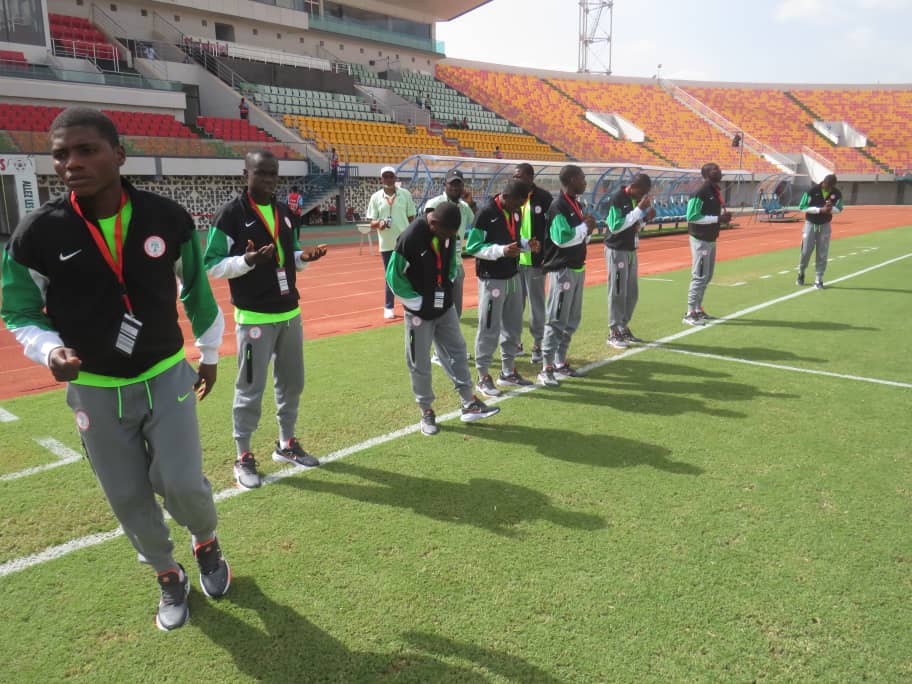
Nigeria's U-17 decline: Time to rebuild, not agonise
By Ruth Dave Williams
We cannot continue mourning the failure of our young footballers without confronting the system that prepares them for the future.
Nigeria’s latest failure to qualify for the FIFA U-17 World Cup is painful. But perhaps the most troubling part of this story is not the result itself. It is the growing possibility that we are becoming accustomed to disappointment at a level where Nigeria once commanded global respect.
The results from the 2026 WAFU B U-17 Boys Cup tell their own story:
🇳🇪 Niger 2 – 1 Nigeria 🇳🇬
🇳🇬 Nigeria 1 – 1 Côte d’Ivoire 🇨🇮
For a country that has won the FIFA U-17 World Cup five times, these results should provoke more than social media outrage, angry headlines, and emotional lamentations. They should provoke a serious national conversation about how we discover, develop, train, and prepare our young footballers.
Nigeria last qualified for the FIFA Men's U-17 World Cup in 2019. Missing the 2027 U-17 AFCON, and consequently the 2027 FIFA U-17 World Cup, would extend a troubling run of three consecutive missed U-17 AFCON tournaments and four consecutive missed FIFA U-17 World Cups.
This is not merely a football statistic. It is a warning sign. But I believe this is the time to work, not simply to agonise.
The Problem is Bigger Than One Tournament
It is tempting to blame the players, condemn the coaches, demand the dismissal of administrators, or describe the entire generation as lacking the talent of those who came before them. These reactions may satisfy our immediate frustration, but they do little to address the underlying problem.
Young footballers do not suddenly become world-class when they arrive at a national camp. Their development begins years earlier, in school playgrounds, community fields, local academies, grassroots competitions, and the training environments available to them. By the time a player puts on the Golden Eaglets jersey, the quality of the preparation behind that player has already shaped much of what we see on the pitch.
If our youth teams are struggling to compete, we must examine the structures responsible for producing the players who represent us: Are our schools playing enough competitive football?
Do our grassroots coaches have the training and resources they need?
Are children being taught the technical and tactical fundamentals of the game early enough?
Do our competitions provide consistent, meaningful opposition?
Can we reliably identify and track talented players across the country?
These are the questions that deserve our attention. We cannot continue to expect exceptional outcomes from a system that does not consistently provide exceptional preparation.
It is Time to Re-Energise School Football
One of the most important places to begin rebuilding Nigerian football is the school system. Schools offer a natural foundation for identifying talent because they bring together children from different backgrounds and communities. With proper organisation, school football can become a dependable source of talent identification, player development, and competitive experience.
But this requires more than announcing an inter-school tournament every year. We need regular competitions at primary and secondary school levels, properly organised zonal and state championships, and a clear progression towards national competitions. School sports must become an integral part of the educational experience rather than an occasional extracurricular activity.
Teachers and physical education instructors should be supported to identify promising players, while partnerships with qualified football coaches and local clubs can help children develop their abilities without sacrificing their education.
The objective should not be to turn every child into a professional footballer. It should be to give every interested child a fair opportunity to play, improve, and discover how far their talent can take them. Some will become professional footballers; others will become coaches, referees, sports scientists, administrators, or lifelong participants in the game.
A functioning school football system can serve all these purposes and, most importantly, widen the talent pool from which Nigeria's future national teams are selected.
Grassroots Development Must Become a System, Not a Slogan
Grassroots football is frequently mentioned whenever Nigerian football encounters a crisis. Unfortunately, the conversation often ends when the immediate crisis passes. We must move beyond that cycle.
Grassroots development requires functional facilities, qualified coaches, organised competitions, reliable administration, player registration systems, talent identification, sponsorship, medical support, and clear pathways through which young players can progress. These are not luxuries; they are the basic building blocks of a sustainable football development system.
A talented teenager playing on a community pitch should have a realistic opportunity to progress to a structured academy, a youth team, a state-level competition, and eventually professional football. That pathway should not depend entirely on personal connections, the ability of parents to pay private academy fees, or the good fortune of being noticed by a visiting scout. Talent exists across Nigeria, the challenge is creating a system capable of finding it, nurturing it, and giving it room to flourish.
We also need an ecosystem in which clubs can survive, competitions can attract commercial partners, and administrators can plan beyond the next match or tournament.
Without financial sustainability, even the most promising grassroots initiatives struggle to survive. Without reliable competitions, players cannot develop consistently. Without qualified coaches, talent can remain technically underdeveloped. Without proper registration and age-verification systems, the integrity of youth football becomes difficult to protect.
Every part of the system matters.
What State Football Associations Must Do
State Football Associations are strategically positioned to connect local clubs, schools, academies, coaches, referees, sponsors, and football authorities.
They can organize competitions, create opportunities for young players, and identify promising talent. They can also strengthen coaching education, improve player registration, and build partnerships that bring additional resources into the game. However, the long-term development of those players depends on the wider system around them.
A talented young footballer cannot fulfil their potential simply because they possess natural ability. They need appropriate training facilities, qualified coaches, competitive football, medical support, and opportunities to progress. This is why grassroots development must be approached as a coordinated responsibility involving State Football Associations, schools, local governments, state governments, clubs, private academies, corporate sponsors, and the relevant national football institutions.
No single institution can solve every problem, but each institution must understand its responsibility and be held accountable for delivering results.
At the state level, they should be asking practical questions:
How many children participate in organised football each year?
How many schools have active football programmes?
How many grassroots coaches receive regular training?
How many registered youth competitions take place annually?
How many promising players progress from local competitions into professional academies and national youth-team structures?
These are the kinds of indicators that can help us measure whether grassroots development is actually happening. We need to replace occasional activity with sustained programmes and replace vague promises with measurable outcomes.
Build the Infrastructure, Train the Coaches, Organize the Competitions
We must also confront the infrastructure question. A country cannot sustainably develop elite footballers if large numbers of young players lack access to safe and suitable places to train.
Grassroots facilities do not all need to be expensive, modern stadiums. Community pitches, school fields, and local training centres can make meaningful contributions when they are properly maintained, accessible, and supported by competent coaches. The priority should be to create functional football environments across our communities.
Alongside facilities, coaching development must receive serious attention. A coach working with children requires more than enthusiasm and a former playing career.
Young players need coaches who understand age-appropriate training, technical development, tactical education, physical conditioning, injury prevention, and safeguarding. Investing in coaches is an investment in every player they train.
Competitions must also be organised around player development rather than merely the pursuit of trophies.
Young footballers need regular match exposure, age-appropriate formats, fair officiating, and opportunities to compete against different styles of play. They need environments in which mistakes become learning opportunities and performance improves over time.
The objective is to develop better footballers, not simply to produce tournament winners.
Technology and Player Registration Must Become Part of the Solution
Modern football development also requires reliable information. We need better systems for registering young players, verifying their identities and ages, recording their participation, and tracking their progress through the football pyramid.
A well-managed player database can help administrators understand where talent is emerging, which communities are underserved, and how young players move between schools, academies, and clubs. It can also support transparency, competition integrity, and long-term planning.
For youth football, these systems must be implemented responsibly, with appropriate safeguards for children's personal information. Talent identification should not be an exercise in guesswork or a process driven entirely by reputation. It should combine informed scouting, technical assessment, consistent competitive performance, and a clear understanding of each player's developmental needs.
The more reliable our information becomes, the better equipped we will be to make decisions about the future of Nigerian football.
Sponsorship: Grassroots Football Must Become Investable
Government funding alone cannot carry the burden of grassroots sports development. We need businesses, philanthropists, foundations, community organisations, and private investors to see youth football as an opportunity to create lasting social and economic value.
But sponsors require more than emotional appeals. They need organised competitions, transparent financial management, credible leadership, measurable outcomes, and audiences that give their investments visibility.
This means grassroots football administrators must learn to package their competitions professionally, communicate their impact, and demonstrate accountability.
A properly organised school championship can attract sponsors interested in education and youth development.
A well-managed grassroots league can provide businesses with community visibility.
A sustainable academy can create opportunities for partnerships involving equipment, coaching, medical services, and player development.
The commercial potential of grassroots football is real, but it must be supported by credible structures. We cannot ask sponsors to invest in programmes that are poorly organised and then complain that the private sector has failed to support the game. We must make grassroots football worth investing in.
This is About More Than the Golden Eaglets
The lessons from Nigeria's U-17 difficulties extend beyond football. The same principles apply to athletics, basketball, volleyball, handball, and other sports in which young Nigerians possess considerable potential.
Every sport requires an environment that identifies talent early, provides appropriate coaching, organises competitions, and creates opportunities for progression. If we want to produce athletes capable of competing internationally, we must pay attention to what happens long before they wear the national colours.
Grassroots sports development is also an investment in public health, education, discipline, employment, community identity, and national pride. It creates opportunities for young people while helping to build careers for coaches, referees, sports scientists, physiotherapists, administrators, and other professionals within the sporting ecosystem.
When sports development is properly organised, it becomes more than recreation—it becomes an industry capable of generating economic and social value. That is the larger opportunity Nigeria must not overlook.
From National Disappointment to Grassroots Action
The temptation after another youth-football disappointment is to demand immediate solutions. We want a new coach, a new selection process, a new competition, or a new administrative arrangement that will quickly return Nigeria to the global stage.
Some immediate reforms may be necessary, but we must not confuse short-term interventions with long-term development. Even if Nigeria were to qualify for the next available youth tournament, that achievement alone would not prove that the underlying system had been repaired.
Sustainable progress requires continuity, investment, accountability, and patience. We need:
A national commitment to school football
Properly supported grassroots coaches
Regular, structured competitions
Functional local facilities
Reliable player registration and talent identification
Financially sustainable clubs and academies
Clear pathways connecting community football to elite performance
We must also evaluate our programmes honestly, learn from countries that have built effective youth-development systems, and adapt useful lessons to Nigeria's circumstances.
Most importantly, we must begin now. Not when the next qualification campaign arrives. Not when another generation of young footballers disappoints us. Not when the next tournament exposes the same weaknesses.
The Final Whistle is Not the End
Nigeria's history at the FIFA U-17 World Cup demonstrates that the country possesses a rich football tradition. But history is not a development strategy, and past victories cannot substitute for present investment.
We cannot keep invoking the achievements of previous Golden Eaglets generations while failing to create the conditions that will allow the next generation to succeed. Our young footballers deserve better than being blamed for weaknesses they did not create. They deserve functional facilities, competent coaching, meaningful competitions, proper medical support, and genuine opportunities to progress.
The failure to qualify should therefore become a moment of reflection and reform, not another occasion for national mourning that fades from public consciousness after a few days. It is time to stop agonising over the decline of Nigerian youth football and start rebuilding the system that produces our players.
Let us return football to our schools. Let us strengthen our grassroots competitions. Let us invest in our coaches, support our clubs, improve our administration, and create pathways for our young talents.
Let every State Football Association examine what it can do better. Let governments recognise grassroots sports as an investment in our young people. Let the private sector see the opportunities in a properly organised sporting ecosystem.
The Golden Eaglets will not be rebuilt by lamentations on social media. They will be rebuilt on school fields, community pitches, training grounds, and well-organised competitions across Nigeria.
The next generation of Nigerian footballers is already growing somewhere in this country. Our responsibility is to build a system worthy of their talent.
That is where the work must begin, and that is where it must continue long after the headlines have disappeared.


