
President Tinubu moves to revamp grassroots sports development with National Summit
President Bola Ahmed Tinubu is set to drive a renewed national agenda for grassroots sports development, with his administration seeking to establish a comprehensive framework for identifying, nurturing and transforming Nigeria’s untapped sporting talents into professional athletes and global champions.
The initiative will take centre stage at the National Grassroots Sports Summit 2026, scheduled for November 18 and 19 at the Banquet Hall, State House, Presidential Villa, Abuja.
The summit is expected to bring together government institutions, sports federations, state and local governments, corporate organisations, development partners, athletes and other stakeholders to develop a sustainable blueprint for repositioning schools and communities as key centres for discovering future sporting stars.
The event is being spearheaded by the Senior Special Assistant to the President on Grassroots Sports Development, Hon. Adeyinka Anthony Adeboye.
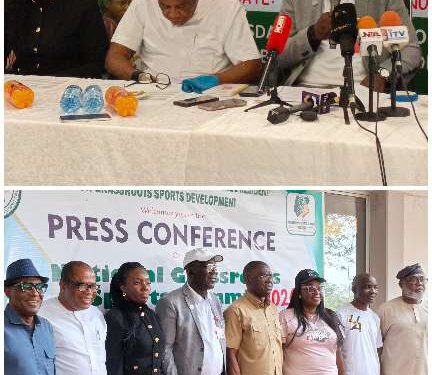
Speaking at a world press conference held at the MKO National Stadium, Abuja, on Thursday, November 5, Adeboye said Nigeria must move away from a sports development system that relies on accidental talent discovery and embrace a coordinated structure that identifies and develops sporting potential from the grassroots.
He lamented that thousands of talented young Nigerians were being denied opportunities to excel because of inadequate facilities, limited access to professional coaching, insufficient funding and weak institutional support.
“Talent is everywhere in Nigeria. Opportunity is not. Our responsibility is to close that gap,” Adeboye declared.
He explained that the Tinubu administration intends to ensure sporting opportunities are no longer concentrated in major cities or limited to children from privileged backgrounds.
According to him, the proposed framework will make every local government area a potential centre of sporting excellence, with schools and communities serving as organised platforms for identifying and developing young athletes.
The summit, themed *“Creating a New Pathway for Sustainable Grassroots Sports Development,”* will focus on five strategic pillars: participation, talent development, infrastructure, sports economy and international pathways.
Under the participation agenda, the initiative seeks to expand access to organised sporting activities for Nigerian children, particularly girls and young people in underserved communities.
The talent development component will prioritise early identification, professional coaching and structured progression from school and community competitions to national and international sporting platforms.
Discussions on infrastructure will focus on developing and maintaining accessible sporting facilities, while the sports economy pillar will explore investment opportunities, employment generation and the commercial potential of grassroots sports.
The international pathways component will examine partnerships that could provide Nigerian athletes, coaches and sports administrators with access to global competitions, professional contracts and international development opportunities.
Adeboye commended President Tinubu for his administration's attention to sports development, particularly the recognition accorded Nigerian athletes following the Super Falcons' historic Women's Africa Cup of Nations victory and the achievements of D'Tigress.
He also highlighted the restoration of the National Sports Commission as part of efforts to strengthen sports governance and institutional coordination.
However, he stressed that Nigeria's sports development agenda must go beyond celebrating established champions to creating opportunities for millions of young people whose talents remain undiscovered.
To strengthen the policy and technical foundations of the summit, Adeboye disclosed that his office was working with the Nigerian Economic Summit Group (NESG) as a technical partner.
He said the collaboration would help generate practical recommendations capable of transforming grassroots sports into a sustainable national development programme.
The presidential aide maintained that the success of the initiative should not be measured solely by medals won at international competitions but also by the number of young Nigerians whose lives are transformed through sports.
He described sports as a vehicle for education, employment, discipline, personal development and protecting young people from negative social influences.
“At the heart of every sporting achievement is a human being. A child with a dream, a young person seeking a chance, and a family hoping for a better tomorrow,” he said.
Adeboye also urged the media to devote greater attention to grassroots sports by identifying emerging talents in rural communities, exposing abandoned sporting facilities and demanding accountability from authorities responsible for sports development.
He challenged corporate organisations to look beyond sponsoring elite competitions and invest in community sports programmes, describing such investments as contributions to Nigeria's future workforce, talent pool and economy.
State governors and local government chairmen were equally urged to prioritise sporting infrastructure and organised competitions, while parents and teachers were encouraged to support children in balancing their education with sporting ambitions.
He also appealed to aspiring athletes not to abandon their dreams because of their present circumstances, assuring them that efforts were underway to create more accessible pathways for their talents to flourish.
Adeboye, however, acknowledged that translating the vision into reality would require continuity, accountability, collective ownership and the political will to implement recommendations beyond the summit.
He commended the Chairman of the National Sports Commission, Mallam Shehu Dikko, and its Director-General, Hon. Bukola Olopade, for their contributions to advancing Nigerian sports.
He also recognised the Main Organising Committee, its sub-committees, technical partners and other stakeholders working towards the successful hosting of the summit.
The proposed national framework is expected to create pathways through which talented young Nigerians can access scholarships, professional sporting contracts, international competitions and sustainable careers within the sports industry.
As the November 18–19 summit approaches, attention will be on how its deliberations translate into concrete policies, accessible facilities, sustained investment and measurable opportunities for young Nigerians.


