
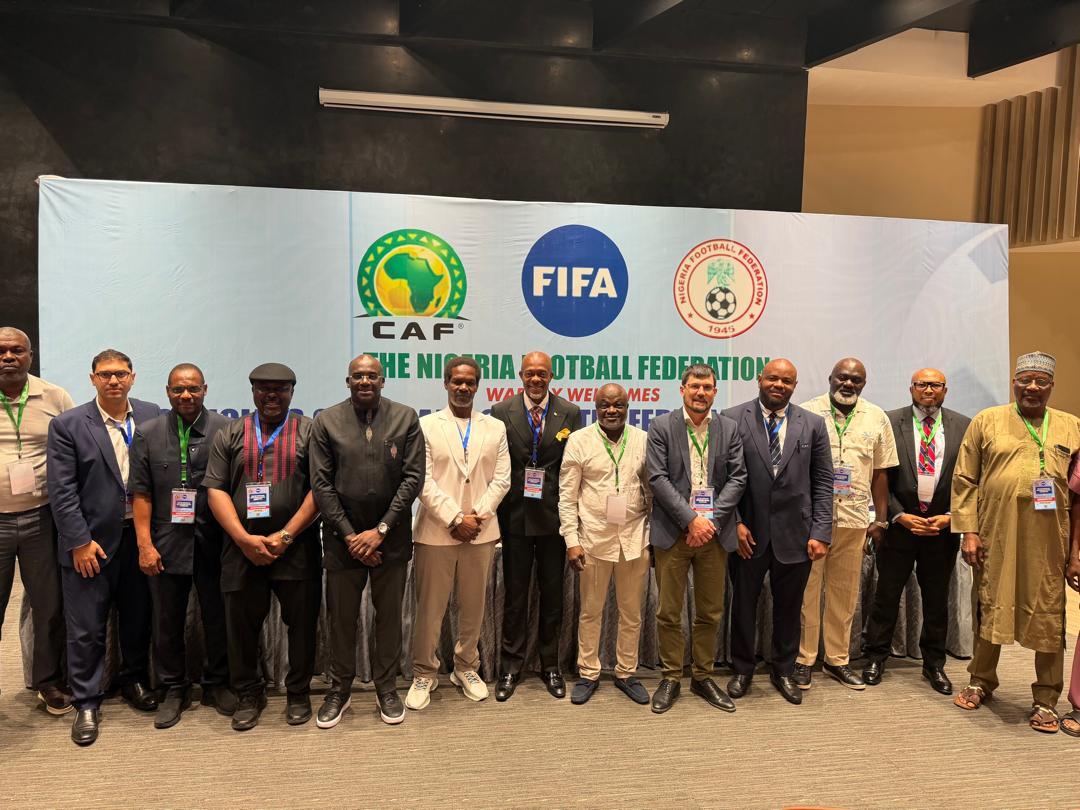
NFF Crisis: FIFA, CAF consult stakeholders as Reform Mission enters final day
The joint FIFA and Confederation of African Football (CAF) assessment mission on Nigeria’s football crisis enters its final day on Tuesday after a series of meetings with key stakeholders produced sharply contrasting positions on how the Nigeria Football Federation (NFF) leadership vacuum and proposed reforms should be addressed.
The four-man delegation has been holding consultations in Abuja with major stakeholders as part of efforts to understand the circumstances surrounding the resignation of the former NFF leadership and determine an acceptable pathway for restoring a functioning federation.
The delegation includes FIFA Member Association Governance Services team lead Ahmed Harraz, FIFA Head of Member Association Governance Rolf Tanner, FIFA Regional Office for West Africa lead El Hadj Wack Diop and CAF Legal Manager Nnaemeka Olu.
The mission follows the mass resignation of former NFF President Ibrahim Musa Gusau, General Secretary Mohammed Sanusi and members of the federation’s Executive Committee, which created a leadership vacuum at the country’s football governing body.
FIFA subsequently accepted the resignations while stressing that engagements on a comprehensive reform roadmap would continue. The NFF Secretariat is currently being overseen by Acting General Secretary Dr Emmanuel Ikpeme.
The FIFA and CAF representatives first met with National Sports Commission Chairman Shehu Dikko, who briefed the delegation on the government’s proposed reform agenda for Nigerian football.
The international bodies subsequently engaged members of the NFF Congress and other constituencies, including State Football Association chairmen, league bodies, players’ representatives, the Sports Writers Association of Nigeria (SWAN) and former NFF officials.
One of the major issues emerging from the consultations is the disagreement over the mechanism to be used during the transition period.
State FA chairmen, who constitute an important bloc within the NFF Congress, have argued that the federation’s existing statutes provide mechanisms for resolving the leadership vacuum without bringing in an external structure.
Chairman of the Gombe State FA, Yakubu Sarma, who led the State FA chairmen’s delegation, said they informed FIFA and CAF that Nigerian football was not in crisis, although there was a leadership vacuum at the NFF.
According to Sarma, the leagues remain active, Nigerian clubs continue to participate in continental competitions, national teams are functioning and the NFF Secretariat remains operational. He maintained that the NFF Congress can use the federation’s statutes to address the leadership gap.
The FA chairmen also rejected the idea of an externally imposed Normalisation Committee, instead advocating an interim or caretaker arrangement driven by the NFF Congress.
The position has added another layer to an already complex reform debate, particularly as FIFA and CAF assess the electoral framework, the composition of Congress and the appropriate legal route for restoring elected leadership.
The international delegation is also examining the NFF statutes, the suspended electoral process, the proposed timetable for an elective Congress and the role of government in the federation’s affairs.
The question of whether Nigeria should pursue an internally constituted transition or a FIFA/CAF-backed normalisation process has therefore emerged as one of the most consequential issues before the mission.
Reports from the stakeholder consultations indicate that the FA chairmen are strongly pushing for an interim structure, while the debate continues over the provisions contained in the football governing framework and the extent to which the NFF Congress should control the transition.
However, FIFA and CAF have yet to announce a final decision on the country’s reform pathway. Their current engagement remains an assessment and consultation exercise rather than a formal announcement of a new governing structure.
The mission is expected to conclude its consultations on Tuesday, after which FIFA and CAF will assess the submissions from the various stakeholders and determine the next steps under the applicable FIFA, CAF and NFF regulatory frameworks.
The outcome could have far-reaching implications for the future structure of Nigerian football, including the restoration of the NFF Congress, the electoral process, representation within the federation and the broader governance reforms being demanded by stakeholders.
For Nigerian football stakeholders, the expectation is that the process will produce a transparent, lawful and inclusive roadmap capable of restoring stability while addressing the structural weaknesses that have repeatedly triggered crises around NFF elections.
The final recommendations from FIFA and CAF are therefore expected to be closely watched as Nigerian football enters a potentially decisive phase in its governance reform process.


