
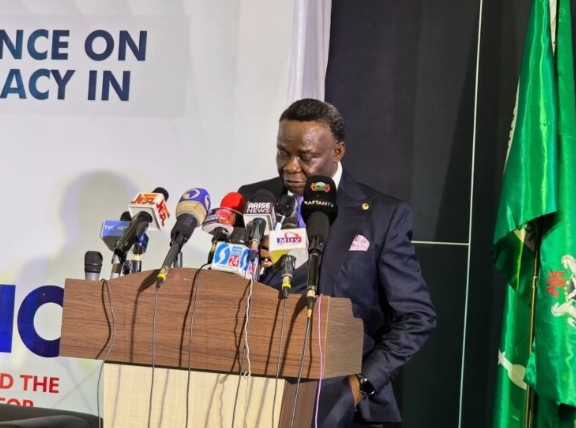
PAACA Conference Calls for Democratic Reforms Beyond Elections
Stakeholders at a conference organised by the Peering Advocacy and Advancement Centre in Africa (PAACA) have warned that Nigeria’s democracy faces a growing crisis of citizen disengagement and institutional weakness, calling for urgent reforms that go beyond periodic elections.
The event, themed “Sustaining Democratic Reforms Beyond the Polls for Effective Governance,” brought together activists, scholars, and governance experts in Abuja to examine the widening gap between electoral processes and good governance.
The conference held just days after the Anambra governorship election, which recorded extremely low voter turnout. At one polling unit monitored by observers from the Centre for Transparency Advocacy (CTA), only three out of more than 200 registered voters cast their ballots, underscoring declining public confidence in the electoral system.
‘Democracy cannot end at the ballot box’
In his opening remarks, PAACA Executive Director, Ezenwa Nwagwu, said Nigeria has made noticeable progress in electoral integrity and citizen participation but stressed that the country is still far from achieving a democracy that delivers for its people.
“Nigeria has made important strides in strengthening electoral integrity and broadening citizen participation, yet the journey toward a democracy that truly delivers for all its citizens is far from complete,” he said, urging stakeholders to chart “actionable pathways for sustaining reforms that will endure well beyond election cycles.”
‘Those running democracy don’t believe in it’
Delivering a keynote intervention, the Country Director of CARE International, Dr. Husseini Abdu, issued a stark warning about the values driving Nigeria’s political class.
“Our democracy today is being run by people who don’t actually believe in democracy,” he said. “Their relationship with democracy is only to the extent that it serves their interests. Once institutions or legal frameworks no longer guarantee those interests, they work to undermine them.”
Abdu criticised the recurring cycle in which reforms to strengthen the electoral process are sabotaged within a single election season, noting that political parties themselves struggle to conduct credible internal elections.
Experts fault Nigeria’s democratic model
In his keynote address, the Benue State Resident Electoral Commissioner, Prof. Sam Egwu, argued that Nigeria is practicing a distorted form of democracy inconsistent with constitutional provisions.
He said the 1999 Constitution commits Nigeria to a model of social democracy built on citizen welfare, yet successive administrations have instead pursued a “confused version of liberal democracy” influenced by global financial institutions.
Egwu noted that while Nigeria appears to consolidate democracy on paper, its governance outcomes continue to fall short of citizens’ expectations, weakened further by over-centralisation and the declining capacity of states and local governments.
Parties lack ideology, citizens losing faith
Former presidential candidate, Dr. Gbenga Olawepo-Hashim, observed that many Nigerians have lost confidence in democratic governance due to persistent socioeconomic hardship. He noted that some young people now openly admire authoritarian alternatives, reflecting deep disillusionment.
He added that political parties have largely become vehicles for personal ambition rather than platforms for ideas, ideology, or reform, warning that “a democracy without ideas will always produce leaders without vision.”
Call to action
Participants at the conference agreed that restoring public trust in Nigeria’s democracy requires strengthening institutions, enforcing constitutional provisions on citizens’ welfare, reforming political parties, and promoting accountability beyond elections.
They stressed that while Nigeria does not lack policy ideas or reform recommendations, it continues to suffer from weak political will and a leadership culture that prioritises personal interest over national progress.


