
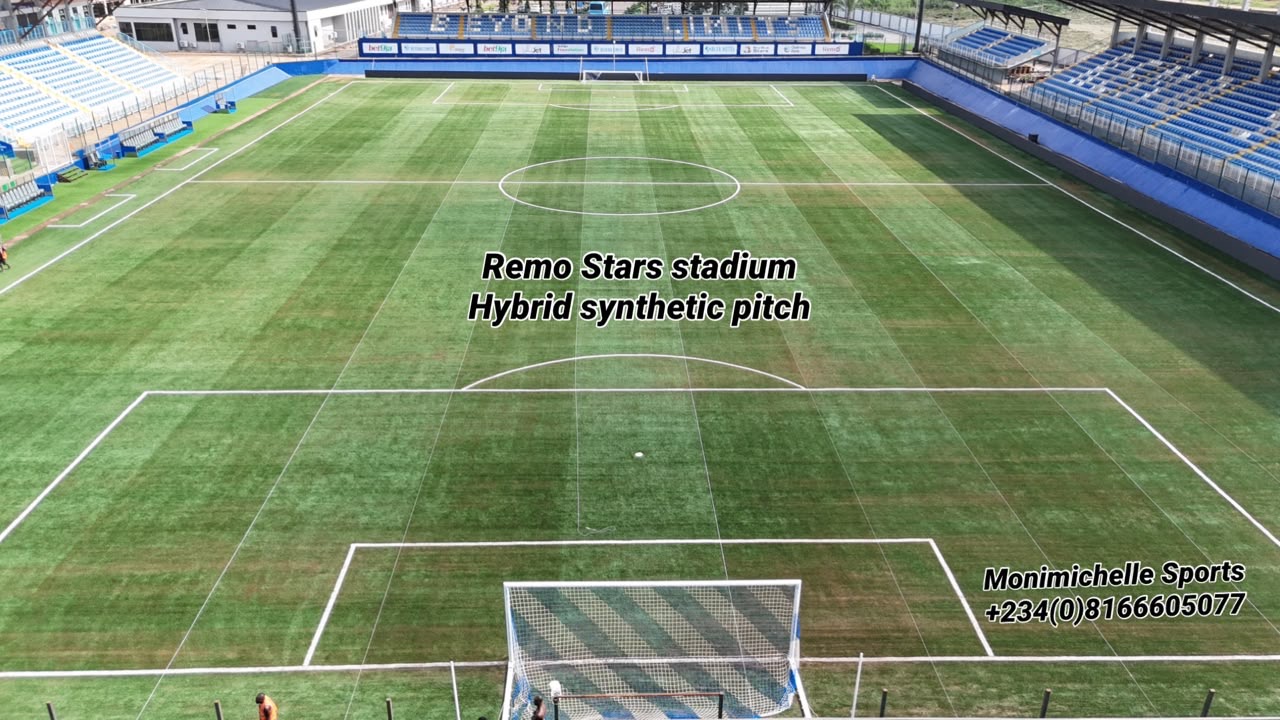
Stop building pitches for commissioning photos, Ebi Egbe tells Nigerians
The Chief Executive Officer of Monimichelle Sports Facilities and Construction Limited, Ebi Egbe, has challenged the growing campaign for 100 per cent natural-grass pitches in Nigeria, insisting that poor maintenance, rather than the type of playing surface, remains one of the biggest threats to the country’s football infrastructure.
Egbe argued that natural grass can provide an excellent playing surface when properly designed, constructed and professionally maintained, but warned that insisting on natural grass without establishing the systems required to sustain it could leave Nigerian football facing the same cycle of deteriorating pitches.
The sports facility expert said the central questions in Nigeria’s pitch-development policy should go beyond whether a surface is natural, hybrid or synthetic.
Instead, he said stakeholders must establish whether the country has the financial resources, technical expertise, equipment and maintenance culture required to keep each facility consistently playable.
“Who will maintain it? What is the maintenance budget? Where are the qualified groundsmen? Where are the pitch maintenance machines?” Egbe asked.
He particularly questioned what happens to newly constructed facilities months after their commissioning, warning against a culture where significant attention is given to unveiling ceremonies but little provision is made for the long-term operation and maintenance of the facilities.
Egbe maintained that a football pitch is not simply a piece of landscaping but living sporting infrastructure that requires continuous investment, scientific management, specialised machinery, qualified groundsmen and strict maintenance schedules.
He also cautioned against judging a pitch solely by its appearance, noting that an attractive surface can still fail critical performance requirements such as hardness, traction, ball behaviour, uniformity, shock absorption, stability, drainage and overall playability.
For him, Nigeria’s conversation should therefore shift from the percentage of natural or synthetic grass to selecting the technology that can be sustainably maintained according to the climate, usage pattern and demands of each venue.
“If 100 per cent natural grass can be properly maintained, use it. If a hybrid system provides the required performance and can be sustainably maintained, use it. If a certified synthetic system is appropriate for a particular venue and usage pattern, use it,” he said.
Egbe stressed that players and the game ultimately respond to the performance of a playing surface rather than the label attached to it.
“Players do not care whether the grass was marketed as 100 per cent natural,” he said.
He cited the Steven Keshi Stadium in Asaba, Lekan Salami Stadium in Ibadan, Samuel Ogbemudia Stadium in Benin City, Teslim Balogun Stadium in Lagos, Adokiye Amiesimaka Stadium in Port Harcourt, Kwara State Stadium Complex in Ilorin and the National Stadium in Abuja among natural-grass projects that, in his assessment, have struggled to consistently maintain the standards required for elite football.
The Monimichelle boss argued that the difficulties experienced by several Nigerian venues in meeting the requirements for CAF continental fixtures should trigger a broader review of how football pitches are designed, constructed and maintained across the country.
His comments are consistent with his wider position that Nigeria’s stadium problem is fundamentally about functionality and sustainability. In a recent interview, Egbe argued that the country does not necessarily lack stadiums but lacks enough functional stadiums, pointing to poor substructure, drainage, irrigation and maintenance frameworks as recurring weaknesses.
“Let us stop building pitches for commissioning day photographs. Let us start building pitches for matchday reality,” Egbe said.
He maintained that the debate should not be reduced to natural grass versus synthetic or hybrid systems, but should focus on delivering safe, durable and consistently playable surfaces.
“The greatest enemy of Nigerian football is not synthetic grass. It is not hybrid grass. It is not natural grass. The real enemy is a pitch we cannot sustain,” he declared.
Egbe called for a football infrastructure policy that places long-term maintenance and professional facility management at the centre of every new project, arguing that maintenance should be considered from the design stage rather than treated as an afterthought.
He also stressed the importance of matching pitch technology to the demands of individual venues, including the frequency of use, climatic conditions, available maintenance resources and the level of competition to be hosted.
The facility expert concluded that Nigeria must move beyond attractive commissioning ceremonies and develop football infrastructure capable of delivering reliable playing conditions throughout its operational life.
“Football needs a playable pitch, not merely a beautiful story and content pictures about it,” he said.


