
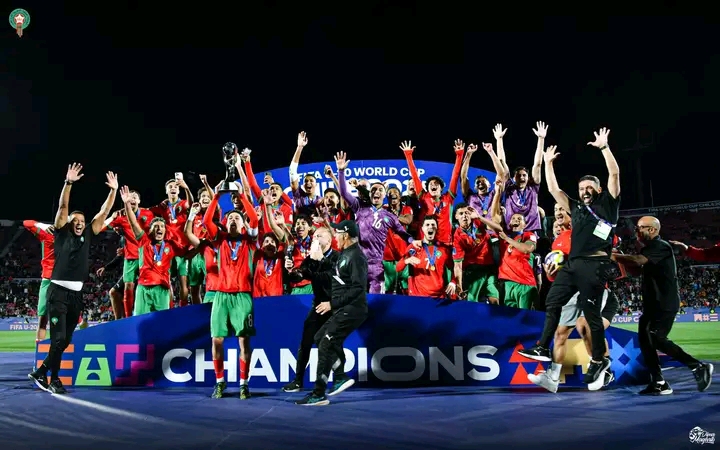
Crowning Glory: Morocco's U-20 World Title and Mohammed VI Football Academy that built a generation
A new era dawns for Moroccan football. In Santiago, Chile, at the iconic Estadio Nacional Julio Martínez Prádanos, the Morocco national under-20 football team sealed a 2–0 victory over six-time champions Argentina to claim the 2025 FIFA U-20 World Cup — the first time an Arab nation has lifted the trophy.
This triumph is the product not of luck, but of a methodical and visionary national project — whose beating heart is the Mohammed VI Football Academy in Salé. The academy has become the engine of Morocco’s football renaissance, combining elite training, education, and infrastructure to deliver world-class results.
The Academy: Blueprint of Excellence
Founded in 2009 and inaugurated by King Mohammed VI, the Mohammed VI Academy covers roughly 18 hectares and was built at a cost of approximately 140 million dirhams.
It features multiple FIFA-standard pitches — natural grass, synthetic turf, indoor training areas, and half-fields — alongside a hydrotherapy pool, a medical center, and full boarding facilities.
But beyond the pitches lies its true innovation: the integration of education and sport.
The academy includes classrooms, computer and language labs, and a curriculum that balances football training with academic excellence — ensuring that players graduate as both athletes and well-rounded citizens.
Recognized by the International Federation of Football History & Statistics (IFFHS) and even FIFA as one of the leading youth academies in Africa, it is celebrated as “an engine that is reshaping the Moroccan game.”
It has already produced top professionals like Youssef En-Nesyri, Azzedine Ounahi, and Hamza Mendyl, all of whom have gone on to represent Morocco at senior international level.
The Road to the Final
Morocco’s path to glory was defined by structure, resilience, and tactical intelligence.
They topped a tough Group C that featured Spain, Brazil, and Mexico — a testament to their growing confidence and quality. Even after a narrow loss to Mexico, they advanced with maturity and composure.
In the semi-final, Morocco stunned European champions France, drawing 1–1 before holding their nerve to win 5–4 on penalties — a result hailed by the Confederation of African Football (CAF) as both symbolic and historic.
In the final, Morocco’s compact pressing, fluid transitions, and clinical finishing overwhelmed Argentina. Every movement reflected months of preparation and years of developmental planning.
---
Zabiri: The Star of Santiago
If the final had a single defining figure, it was Yassir Zabiri.
A 19-year-old forward molded at the Mohammed VI Academy, Zabiri delivered a performance that announced him to the world.
His 15th-minute free-kick — a curling masterpiece over the wall — lit up the stadium. Thirteen minutes later, his instinctive volleyed finish doubled Morocco’s lead and sealed their destiny.
With five goals in the tournament, Zabiri claimed the Golden Boot and the admiration of millions. His style — composed yet expressive, bold yet disciplined — encapsulates the Academy’s DNA: creativity forged through structure.
A National Vision Realized
This U20 triumph adds another milestone to Morocco’s golden decade.
From the senior team’s 2022 World Cup semifinal run — the first by an African or Arab nation — to the U23 AFCON title, and the impressive performances of the U17 and women’s national teams, Moroccan football’s ascent has been steady and deliberate.
Behind it all lies a single unifying vision — the royal roadmap set by King Mohammed VI, centered on infrastructure, education, and opportunity.
The King personally congratulated the U20 team, praising their “self-confidence, harmony, and collective spirit,” calling the victory “a first of its kind in Moroccan football history.”
What It Means for the Future
This World Cup triumph reverberates far beyond the trophy lift:
Global recognition: Morocco has joined the world’s football elite, proving that Africa’s developmental systems can produce world champions.
Rising ambitions: With a generation molded in world-class conditions, Morocco’s senior side now boasts unprecedented depth.
A model for Africa: The Mohammed VI Academy’s integration of education and sport sets a continental standard for sustainable football development.
Talent export: As more academy graduates gain attention from top European clubs, Morocco’s football economy and reputation continue to expand.
From Salé to Santiago: A Journey of Vision and Realization
What began sixteen years ago as a royal initiative in Salé — to build infrastructure, cultivate youth, and professionalize the game — has blossomed into global triumph in Santiago.
Behind the goals, the flags, and the celebrations lies a deeper truth: this victory is a validation of belief, planning, and purpose.
The Mohammed VI Academy is not just where players are trained; it is where a nation’s football dream was methodically constructed.
Morocco’s golden generation has arrived — built from vision, powered by education, and crowned on the world stage.


