
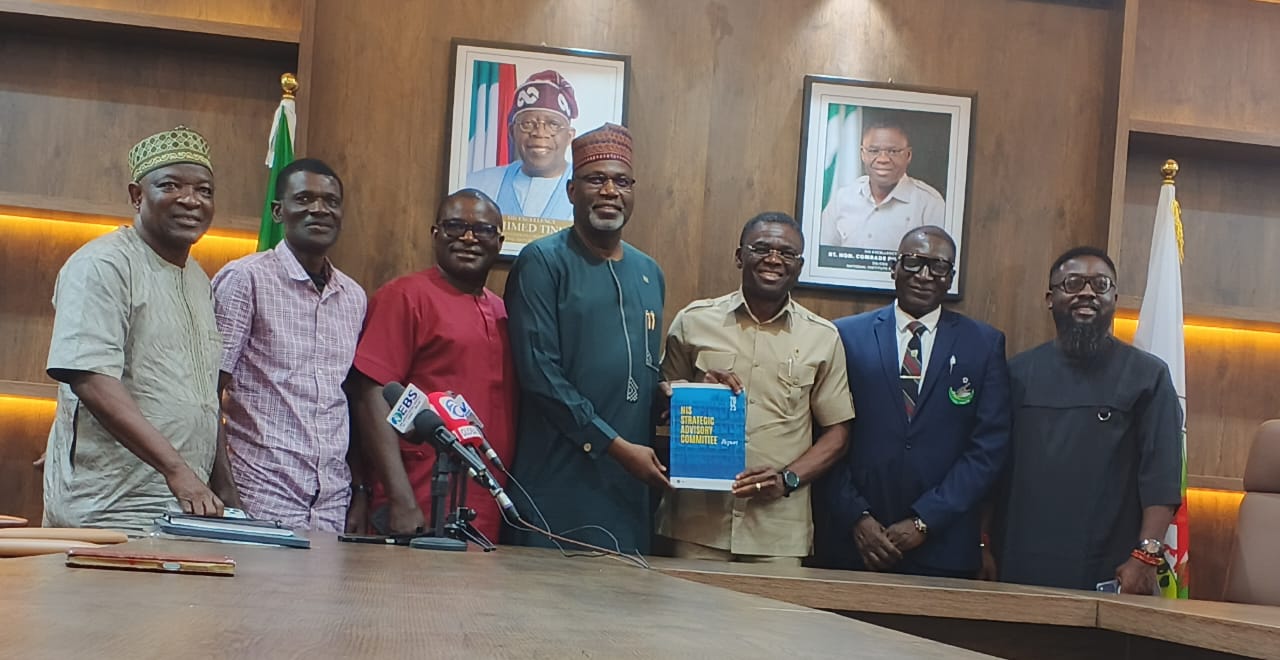
NIS Advisory Committee submits report, implementation to follow - Shaibu
The Advisory Committee set up to revitalise the National Institute for Sports (NIS) has formally submitted its report to the institute’s leadership, headed by Director General Philip Shaibu.
The 32-member committee, inaugurated on July 21, comprises some of Nigeria’s most accomplished professionals drawn from sports, academia, corporate management, and the media.
During the report presentation ceremony, Shaibu commended the committee for its dedication and thorough work, assuring that the recommendations would not be left idle but fully implemented.
“I want to thank the committee for the hard work in producing this rich report. It will not just sit on the shelves; we will implement the recommendations and ensure the goals are achieved,” Shaibu said.
He revealed that while the Advisory Committee has now been dissolved, an Implementation Committee will soon be inaugurated to oversee the execution of the report’s recommendations.
“The Director General will not be the only one to drive implementation,” he added.
“An Implementation Committee will be set up to ensure the report is effectively acted upon. There is no better time to transform Nigerian sports than now, given President Tinubu’s keen interest in sports development.”
Shaibu also announced plans to decentralise the NIS by establishing zonal offices across the six geopolitical zones — a move aimed at expanding the institute’s reach and deepening its impact.
“The six geopolitical zones will have their own NIS offices, which will be implemented soon. Our mandate is to position the NIS as a leading sports institute in Africa,” he stated.
In his remarks, the chairman of the Advisory Committee, Engineer Musa Kida, described the report as a comprehensive and forward-looking document designed to address the institute’s key challenges.
“It’s a great pleasure to submit this tailor-made solution report,” Kida said.
“This document fills the gaps that have long existed in the NIS. The diversity of the committee ensured that the report provides inclusive, practical recommendations.”


